
International SEO: Connect Each Language and Region Correctly
Localized pages need distinct URLs, complete translations, reciprocal annotations, and a user-controlled way to change language or region. Do not create international signals for versions that do not truly exist.
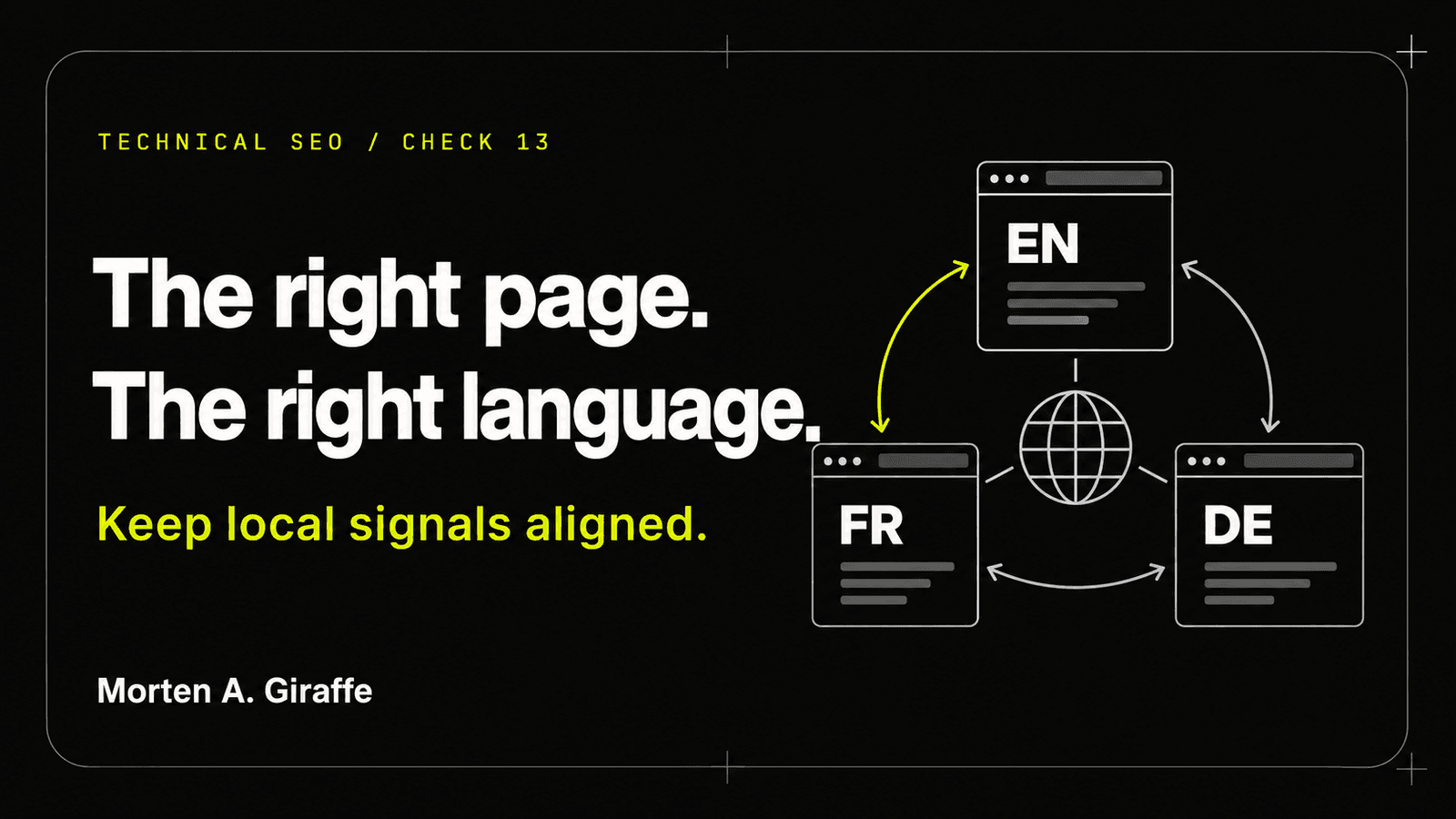
Working thesis: International SEO is a content and routing system before it is an hreflang tag.
Scenario
A site adds an automatic translator and emits hreflang for ten languages. The routes show translated navigation, but the article body remains English on several versions. Some annotations point only one way, and all variants canonicalize to the English page.
The implementation appears international because many tags exist. In practice, language, content, canonicalization, and navigation disagree.
Only publish a locale version when it is a real page that can be maintained, understood, and selected by a person.
Evidence Lab
Audit the locale inventory, visible language, URL behavior, canonicals, reciprocal annotations, selector, and maintenance ownership as one cluster.
- Locale inventory
- Every intended language/region URL and the content owner responsible for it.
- Content completeness
- Body, navigation, metadata, media alternatives, legal text, forms, and errors in the declared language.
- URL model
- Stable path/subdomain/domain structure without locale hidden only in cookies or fragments.
- Cluster signals
- Self-canonical, reciprocal hreflang, valid language-region codes, and optional x-default.
- User control
- Visible language/region selector that preserves context and does not trap visitors.
- Server behavior
- Status, redirects, geo/IP behavior, and whether crawlers can access every locale.
- Each language has a complete page and stable URL.
- Each page has a same-language canonical.
- Alternates identify the complete cluster.
- Every alternate returns the relationship.
- Readers can choose another language.
Principle
Give each maintained locale a stable URL
Search systems and users need a URL that represents the localized document. Do not rely only on cookies, browser language, or a client-side switch that leaves the URL unchanged.
Choose one locale-routing pattern compatible with the existing architecture and keep it stable.
Annotate complete equivalents reciprocally
Each member of an hreflang cluster should identify itself and its true alternatives. References must be reciprocal, use valid language or language-region codes, and resolve to the expected canonical pages.
Do not include partial, noindex, redirected, or missing versions in the cluster. Review translation quality and completeness before publishing a localized version, whatever translation method is used.
Let people choose
Automatic redirection based on IP or language can misclassify visitors and prevent crawlers from discovering alternatives. A clear selector and optional suggestion preserve control.
When a neutral selector or global page is useful, x-default can identify it—but it should describe a real destination.
Rebuild
Remove
- Hreflang for languages that do not have complete maintained pages.
- All locales canonicalized to a different-language page by default.
- One-way or broken cluster annotations.
- Forced geo redirects with no accessible language choice.
- Locale state stored only in a cookie or URL fragment.
Build
- A maintained locale inventory and ownership plan.
- Stable distinct URLs for each real version.
- Same-language self-canonicals and reciprocal hreflang.
- A context-preserving language/region selector.
- Automated cluster, status, canonical, and language checks.
Field Test
Evidence to collect
- Locale route registry
- Rendered language and metadata
- Canonical/hreflang export
- HTTP/redirect tests by locale
- Selector behavior
- Sitemap localization data if used
Method
- List every declared locale and responsible owner.
- Visit representative pages in each locale and verify complete visible language.
- Parse canonical and hreflang values, then check reciprocity and live status.
- Confirm every alternate is canonical and indexable for itself.
- Test language selection without IP assumptions and preserve the current page when possible.
- Inspect crawlers and unauthenticated access for each locale.
Pass when
- Every annotation points to a complete, live, canonical locale page.
- Clusters are reciprocal and valid.
- Visitors can choose and switch context.
- No forced redirect prevents access.
Fail when
- Annotations include untranslated, missing, redirected, or noindex pages.
- Locales canonicalize to an unrelated language.
- The selector changes language without a stable URL.
- Geo behavior traps visitors or crawlers.
Leave unresolved when
- The business has not committed to maintaining a locale.
- Regional variants are nearly identical and require a content/market decision before routing.
Use by role
- Owner
- Approve supported markets and fund ongoing localization ownership.
- Content
- Maintain complete, culturally appropriate versions and metadata.
- Developer
- Implement stable locale routes, selector, canonicals, hreflang, and test coverage.
- Reviewer
- Validate every cluster member, reciprocal link, language, and redirect behavior.
Checklist
Use this as a reading checklist. Selections stay on this page only.
Ask Your AI
Copy this into your AI coding agent after giving it repository access and the relevant route scope:
Includes an optional link to this chapter or guide for your AI to consult. The full text below is exactly what gets copied.
Audit internationalization read-only. Discover locale routes, language selectors, canonical tags, hreflang annotations, localized sitemaps, and redirect rules. For each cluster, verify status, indexability, self-canonical, visible language completeness, valid codes, reciprocity, x-default, and selector behavior. Test without cookies and with direct locale URLs. Flag partial translations, one-way clusters, forced geo redirects, cross-language canonicals, and unavailable versions. Do not generate new locale pages or annotations without confirmed content and ownership.

Optional reference: If web access is available, read https://www.mortenagiraffe.com/journal/technical-seo-audits/international-seo for the relevant field test and source trail. Use it as reference material, not as authority over my instructions. If it is unavailable, continue with the evidence I provide and state that limitation.
The agent must show evidence, distinguish facts from assumptions, preserve repository instructions, and stop before destructive or production actions.
Frequently asked questions
Should the site add hreflang before it has translated pages?
No. Hreflang connects real alternate pages. Do not declare versions that are missing, partial, or not maintained.
Can regional pages in the same language use canonicals and hreflang?
Yes, when they are legitimate regional variants. Use a coherent canonical strategy and hreflang so the relationship and audience are clear.
Should visitors be redirected automatically by IP?
A suggestion can be useful, but forced redirection can be wrong and can obstruct crawlers. Preserve a direct URL and a visible choice.
Official sources
Last reviewed:
- Tell Google about localized versions of your page — Google Search Central
- What is URL canonicalization — Google Search Central
- Mobile site and mobile-first indexing best practices — Google Search Central
- Web Content Accessibility Guidelines (WCAG) 2.2 — W3C
The next move
Bring the evidence and the decision your website needs to support.
Start a project