
Morten, who?
Learning as I go. Building things, raising a family, trying to keep it simple. 🦒
I follow the rabbit hole until it becomes useful.
Not a résumé. Not an origin myth. A map of how I think, build, coach, question, and keep learning.
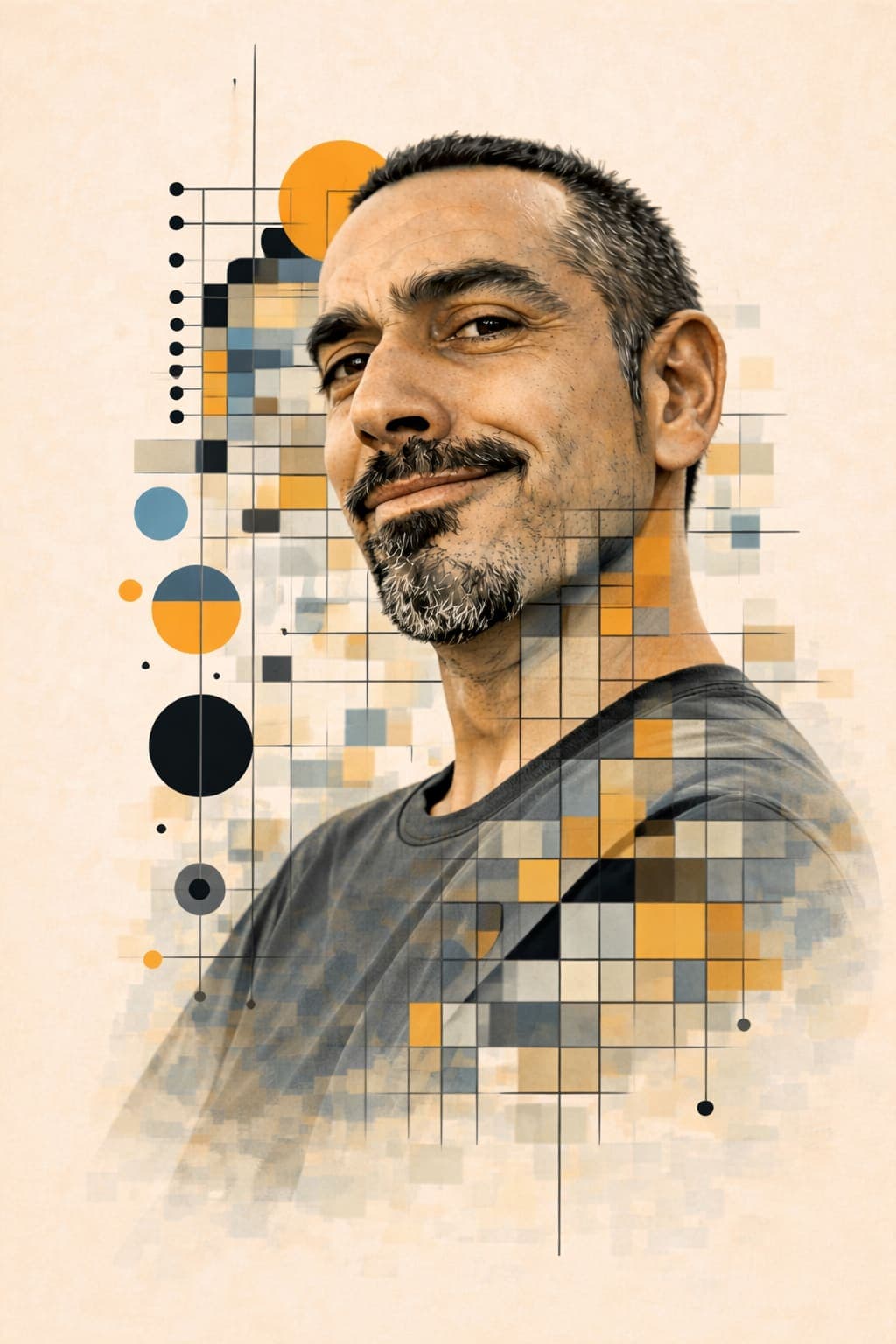
Some people specialize by staying in one lane. I seem to specialize by asking the same question in different rooms:
What is actually getting in the way?
I ask it in businesses, websites, products, football sessions, and ordinary family life. The setting changes. The work is familiar: notice what others have learned to ignore, find the real constraint, make the next move clearer, and build something sturdy enough for real life.
The titles change. The work underneath them does not.
Operator by necessity. Designer by curiosity. Builder by habit. Coach by conviction. Husband and father before any of it.
I build websites, products, systems, and learning environments that make the next action clearer. Most of what I know was learned while something real was on the line. I share what I am still learning because pretending to be finished would be dishonest—and fairly boring.
For services and professional fit, read the full profile.
Most of my education happened with consequences attached.
I did not arrive at design because I wanted to decorate the internet.
I arrived because businesses needed customers, customers needed clarity, teams needed systems, and most websites were making all three harder than necessary.
A customer was waiting. A crew needed an answer. Money was leaving the account. A page had to convert. A system had to survive the person who created it. A young player had to understand an idea well enough to make a decision without an adult shouting the answer. Home still needed me when the laptop closed.
That changes how you think.
You become less interested in what sounds impressive and more interested in what still works on a tired Tuesday.
You learn that a beautiful system nobody can use is not a good system. A clever explanation nobody understands is not clear. A marketing promise operations cannot fulfill is not marketing—it is debt. And a process that only works when everyone is focused, rested, and behaving perfectly does not work.
I build from that reality.
Sometimes the result is a website. Sometimes it is an operating system, a product, a training environment, a dashboard, a clearer offer, or one sentence that finally explains what everyone has been circling around.
The output changes. The instinct does not.
Find the actual problem. Remove what is getting in the way. Make the next action visible. Test it under real conditions. Keep what works. Admit what does not.
Different rooms. Same underlying work.
The disciplines look separate from the outside. From where I stand, they keep asking for the same things: attention, judgment, clarity, responsibility, and a useful next move.
Business operations
Where is friction costing trust, time, or money?
Make ownership, information, and the next action visible.
Websites
What must someone understand before they can act?
Build the structure, language, and interface around that decision.
Products
What has to work when the creator is not in the room?
Create useful defaults, repeatable paths, and recoverable mistakes.
Marketing
Can the operation fulfill the promise being made?
Fix the offer, proof, follow-through, and delivery before buying more attention.
Football
What does the player need to notice and decide?
Build an environment that teaches without stealing the decision.
Home
What is worth protecting from the work?
Time, presence, humor, and enough perspective to know when the screen can wait.
Swipe, scroll sideways, or turn the page.
Built for a tired Tuesday.
I do not trust systems that only work when everyone is having their best day.
Real systems have to survive interruptions, uncertainty, imperfect information, delayed replies, competing responsibilities, and people who are tired.
That is why I care about clear ownership, visible next actions, useful defaults, honest feedback, recoverable mistakes, and fewer things that depend on memory.
The real test is not the launch-day presentation. It is whether the thing still helps when the week gets messy and nobody has extra attention to spare.
A method, not a performance.
Notice before naming
Do not rush to solve the version of the problem someone happened to describe first.
Find the constraint
The visible issue is often a symptom of unclear ownership, missing information, conflicting incentives, or an unnecessary decision.
Make the invisible visible
Map the process. Write the sentence. Draw the flow. Put the decision where people can see it.
Build the smallest honest version
Not the smallest possible version—the smallest one that can fulfill the promise being made.
Test it in reality
A system is not proven by the presentation. It is proven by the person trying to use it.
Document what broke
Failure becomes useful when it changes the next version.
Improve without worshipping novelty
New is not automatically better. Familiar is not automatically outdated. The standard is whether the change helps.
For the delivery sequence, see how a project moves from idea to launch.
Beliefs are only interesting when they change the work.
Clarity before cleverness.
Originality is useful until it makes the next step harder to understand.
Useful beats impressive.
The person using the thing matters more than the person presenting it.
Proof before posture.
Show the work, the constraint, the result, and what still needs improvement.
A promise creates operational debt.
Do not market something the business, product, or team cannot consistently deliver.
Systems should reduce dependence, not dignity.
Automation should remove unnecessary work without treating people like inconvenient parts of the process.
Responsibility scales better than reach.
More attention is not automatically more value.
Children are not development metrics.
In coaching, progress matters, but confidence, curiosity, decision-making, and love of the game matter too.
Boring truths outlast viral advice.
The useful answer is often less exciting and more durable.
You cannot fly if you are not happy.
Ambition that removes all enjoyment eventually becomes another cage.
The polished version is usually missing the useful parts.
I do not have a perfectly linear story.
I do not believe every lesson needs to become a framework.
I do not know everything before I begin.
I use modern tools, including AI, but the presence of a tool does not excuse weak judgment.
I have built things that worked, things that broke, and things that taught me more than they returned.
I would rather show the unfinished reasoning than manufacture certainty after the fact.
The reasoning lives in the Journal’s field guides. The evidence lives in the selected work.
A living page should admit that the work is still moving.
- Products, websites, and operating tools that turn complicated work into clearer decisions.
- Where AI removes real friction—and where it quietly removes judgment.
- Whether the next feature is actually more useful than a better sentence.
- Teaching more clearly, documenting sooner, listening earlier, and leaving enough room for the people I am building for.
Need someone who works this way?
I work directly with a small number of businesses, founders, and teams that need senior-level thinking and hands-on execution—without adding another layer of account management or hiring a full internal team.
Put me on the problem.
$2,000 / week
You bring the difficult, unfinished, or unnecessarily complicated thing.
I help identify the real constraint, clarify what should happen next, and work directly on the solution.
That may include product design, website design, brand systems, user experience, prototypes, practical AI integration, or the workflows connecting them.
- PRODUCT DESIGN
- WEB DESIGN
- BRAND SYSTEMS
- UX + CONVERSION
- PROTOTYPING
- PRACTICAL AI INTEGRATION
- WORKFLOW DESIGN
How the week works
- One important workstream at a time.
- Four meaningful progress deliveries each week.
- Senior direction and hands-on execution.
- Direct communication with me.
- Decisions, priorities, and next actions documented.
- Weekly review and planning.
- Two-week minimum engagement.
What counts as a progress delivery?
A progress delivery is a concrete piece of forward motion: a completed page, tested flow, prototype, brand direction, decision document, implementation, or another agreed output. The exact weekly sequence is set by the active priority and written scope.
Not unlimited requests. Not four disconnected projects at once. One important problem, moved forward properly.
Limited availability. Best for established businesses, founders, and teams with a real problem, access to the necessary people and information, and the ability to act on the work.
This is an inquiry, not checkout. Final scope, timing, and terms are agreed before work begins. Fixed-scope website projects are a separate engagement model.
One question deeper.
Years ago, my email signature borrowed a famous invitation to leave the safe answer and follow the rabbit hole.
I retired the borrowed line, but not the instinct.
I still believe the useful answer is often one question deeper. I simply care more now about whether the answer helps someone, survives contact with reality, and leaves a little more room for curiosity.
And I still believe the other line:
You can’t fly if you’re not happy.