
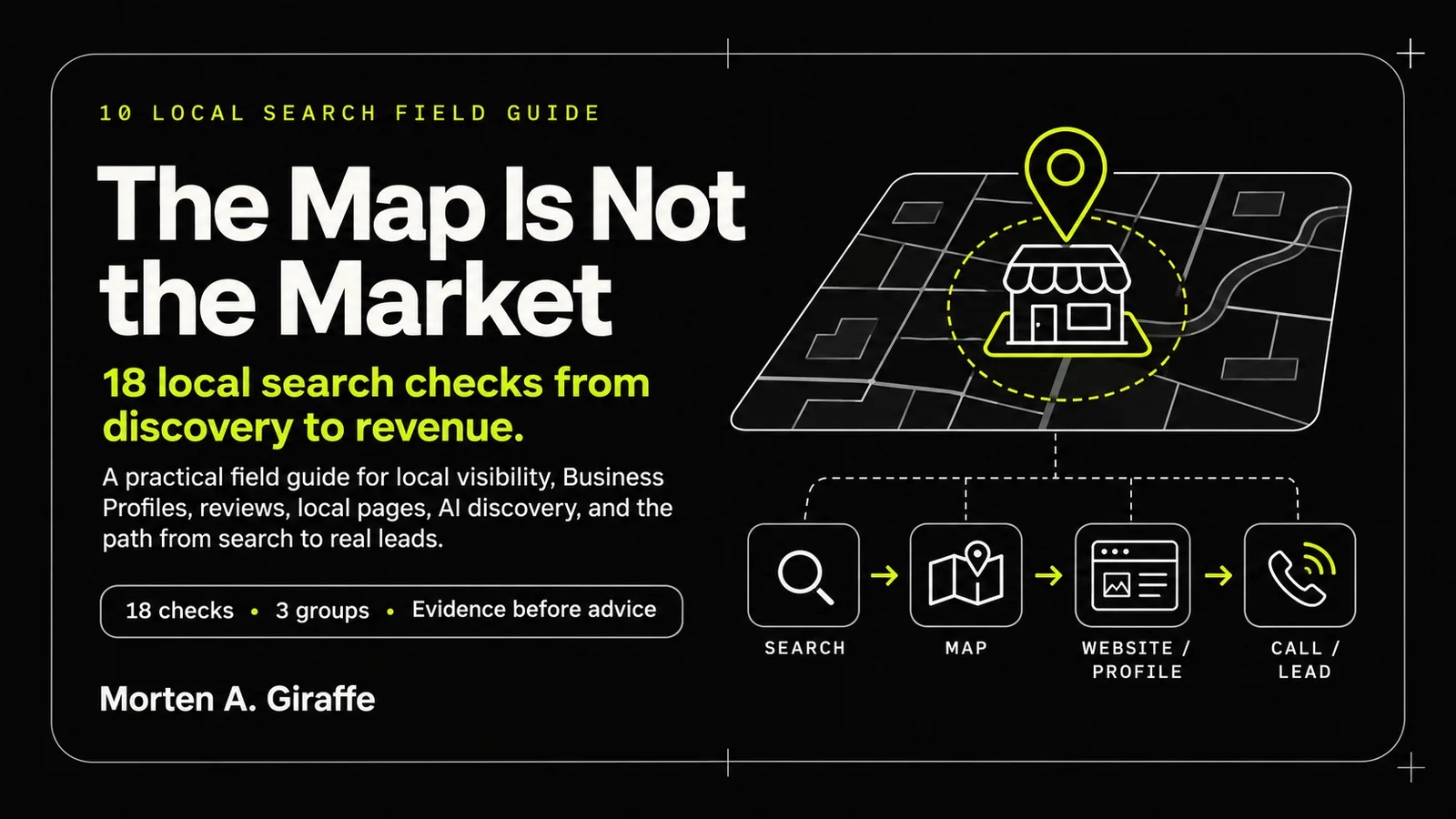
10 / Local Search Field Guide
The Map Is Not the Market
18 practical checks for local visibility, Business Profiles, useful pages and the path from search to real work.
- Checks
- 18
- Groups
- 03
- Working sheets
- 09
- Method
- Evidence first
Evidence before advice. Local search connects a real business to a nearby customer, helps them understand the fit, makes the next action easy and lets the business verify what happened.
Start with the expected state
A rank tracker can show where it observed a result. It cannot decide which market matters, whether a business is represented honestly, whether a landing page answers the customer’s question, or whether a call became qualified work.
Before changing a category, profile field, city page, review workflow, schema object or link, answer these questions.
- What is the real business?
- Which legitimate location or service-area operation is responsible?
- Which customer problem or service are we evaluating?
- Where is the customer?
- What should the profile or search result help them understand?
- Which public page should answer the question?
- What should the customer do next?
- What evidence would prove that path is working?
Local search has layers
- 01Business truth
- The real entity, eligibility, location type, service area, categories, hours, phone and ownership.
- 02Discovery
- How a nearby customer encounters the business through Search, Maps, Apple, Bing, industry sources or AI-assisted discovery.
- 03Understanding
- Whether the profile and website make the business, service, place, proof and limits easy to understand.
- 04Action
- Whether the customer can call, book, request service, visit or order without unnecessary friction.
- 05Outcome
- Whether useful actions became qualified leads, bookings, jobs or another real business outcome.
- 06Durability
- Whether information, links, reviews, pages and measurement remain accurate after the next change.
Use Google’s framework without inventing a formula
Google describes local ranking through relevance, distance and how well-known the business is (prominence). The exact systems are more complex than a three-variable formula, and Google does not publish a universal weight for every tactic. Read Google’s local-ranking guidance.
Some checks below concern that documented framework. Others concern eligibility, accuracy, customer understanding, conversion or measurement. A useful practice is not automatically a ranking factor.
What this guide does not promise
No first-place guarantee, review-count formula, citation quota, backlink shopping list, city-page generator or AI-citation promise. A green grid is an observation. Qualified work is a different outcome.
Run the nearest useful check
Begin with Checks 01–06 to define the business and market. Use 07–12 to align its representation, then 13–18 to protect the customer path and measure what happened. Every check includes a scenario, evidence to collect, a field test and a bounded AI prompt.
For a quick first pass, record Yes, No or Unresolved beside each question in the downloadable checklist. Unresolved means you need evidence; it is not a failure score.
01–06 / Group 1
Establish the local truth
 Check 01
There Is No One Local Ranking: Define the Real Market
Define the searcher.
Read the check Check 02
Baseline Before Changes: Know What Moved
Record before you repair.
Read the check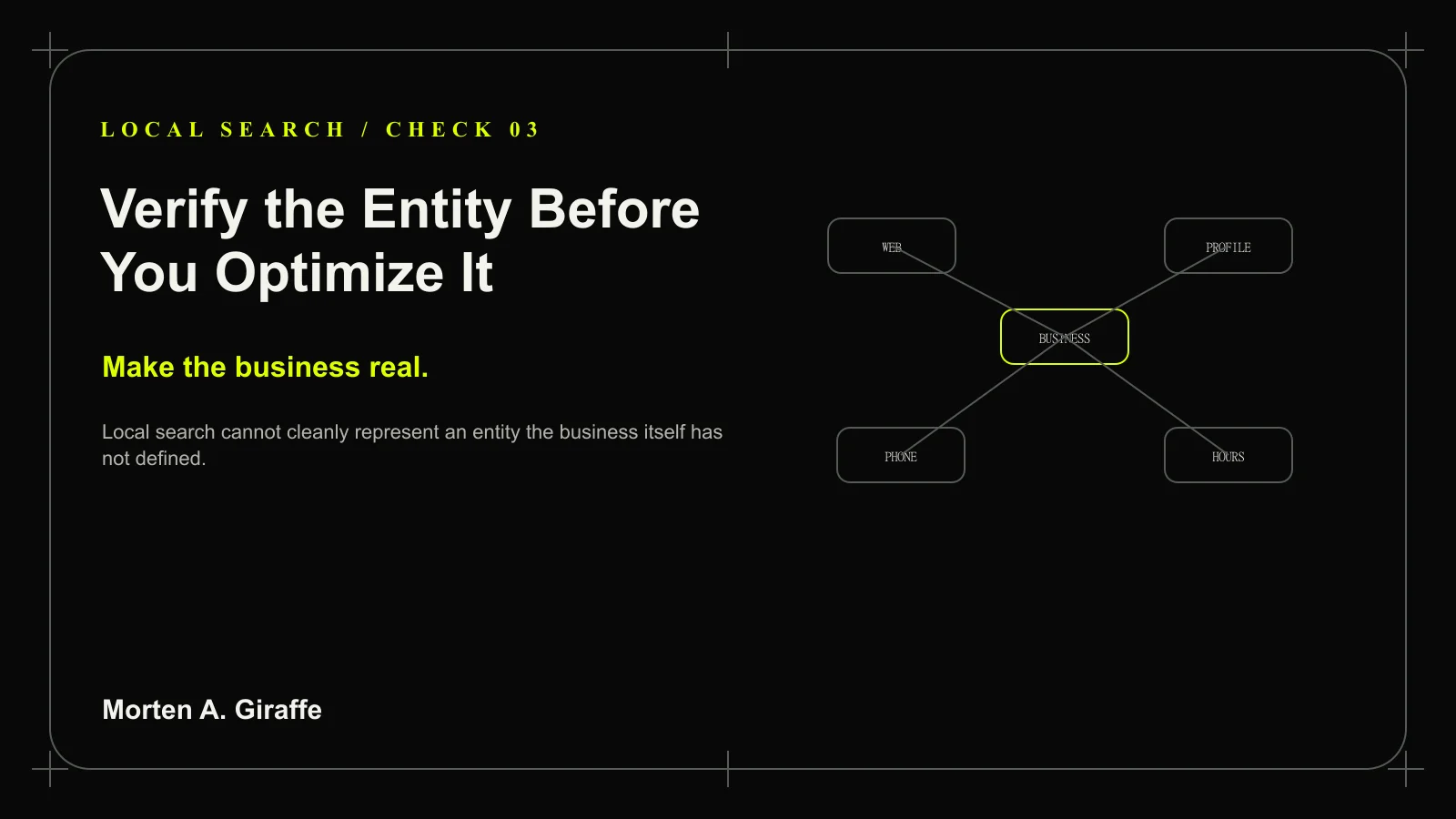 Check 03
Verify the Entity Before You Optimize It
Make the business real.
Read the check Check 04
Choose Categories That Describe What the Business Is
Describe, do not stuff.
Read the check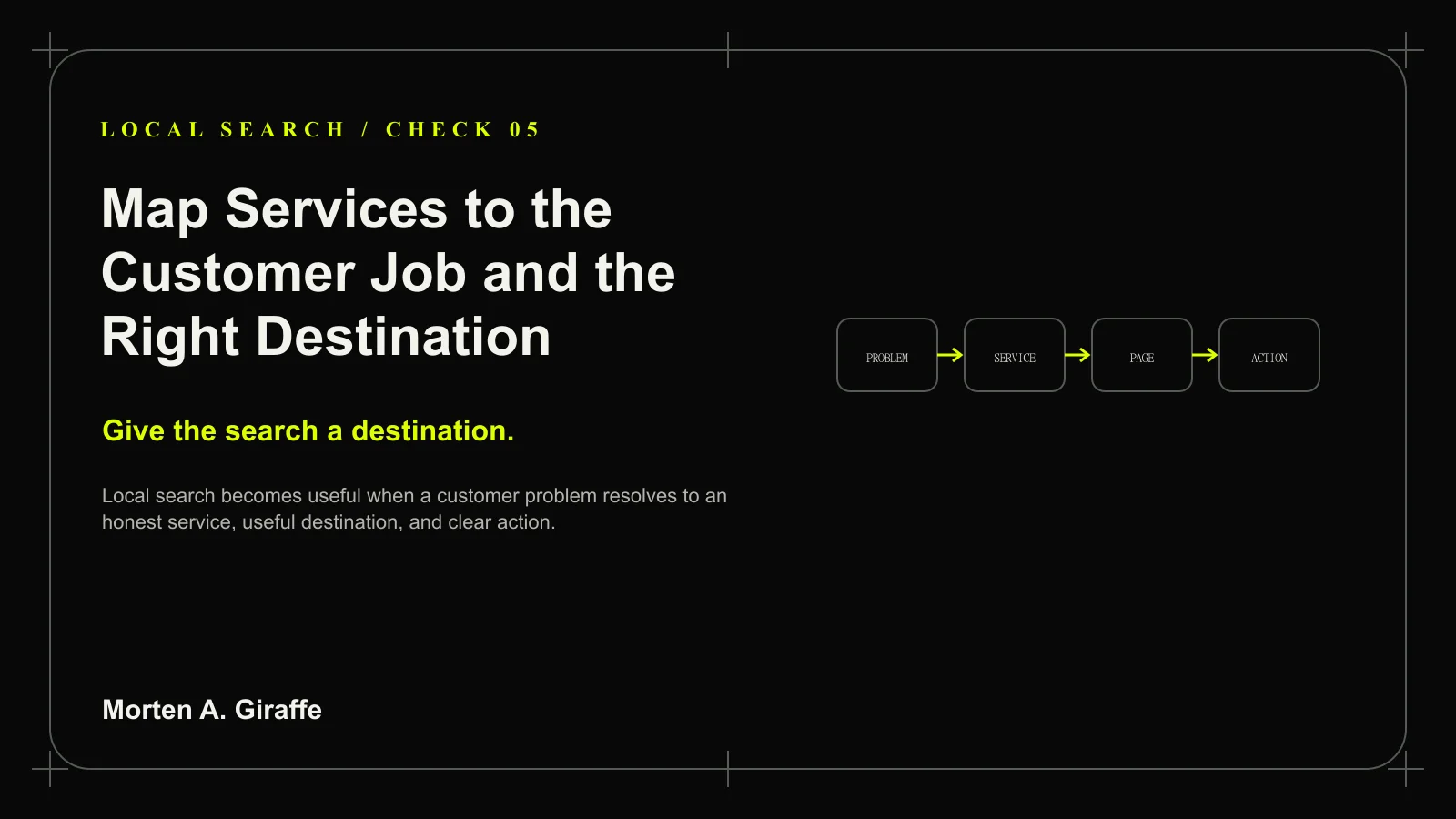 Check 05
Map Services to the Customer Job and the Right Destination
Give the search a destination.
Read the check Check 06
Sample Geography Carefully: A Grid Is Evidence, Not the Market
Sample, compare, repeat.
Read the check
07–12 / Group 2
Make the business understandable
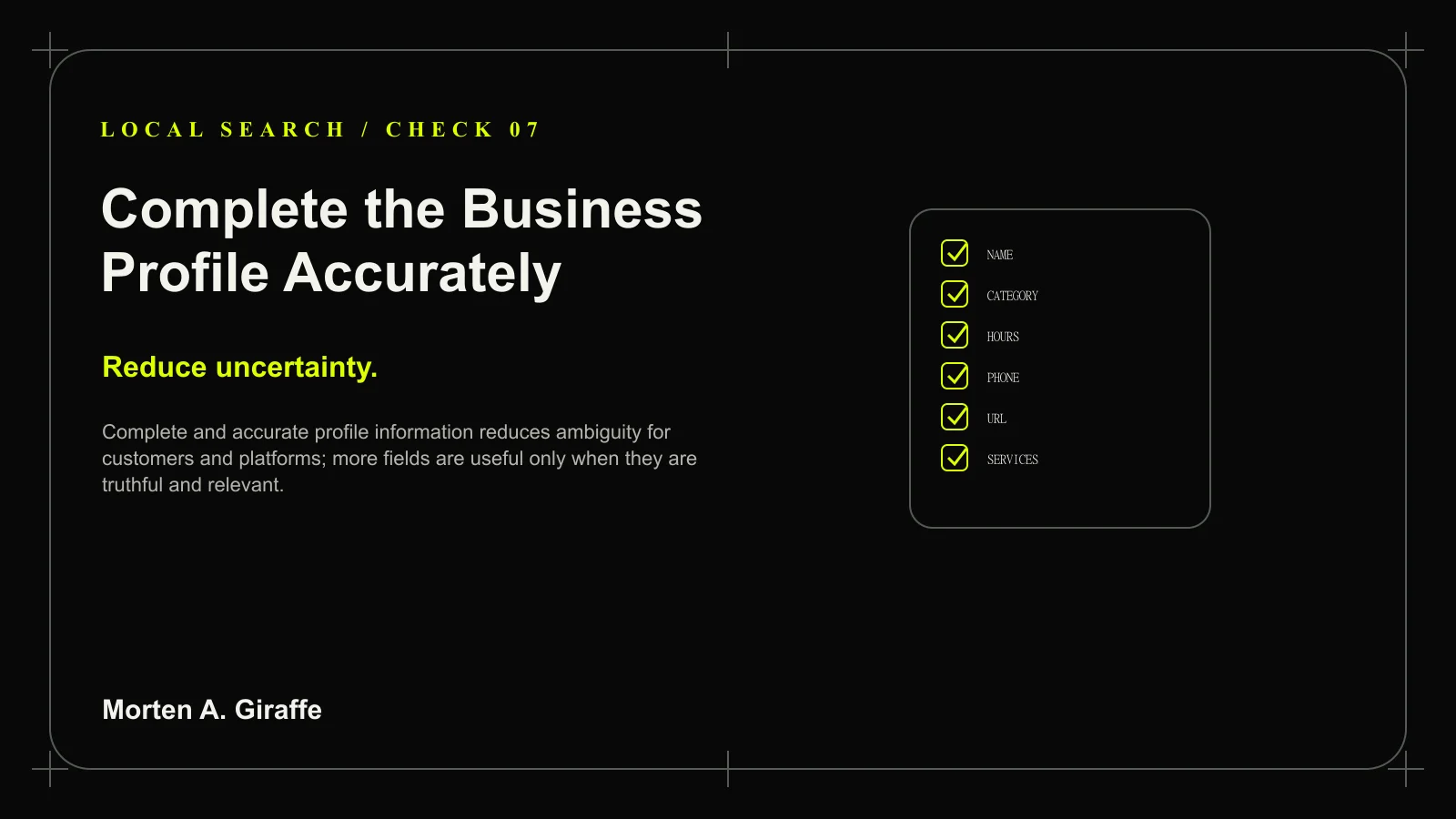 Check 07
Complete the Business Profile Accurately
Reduce uncertainty.
Read the check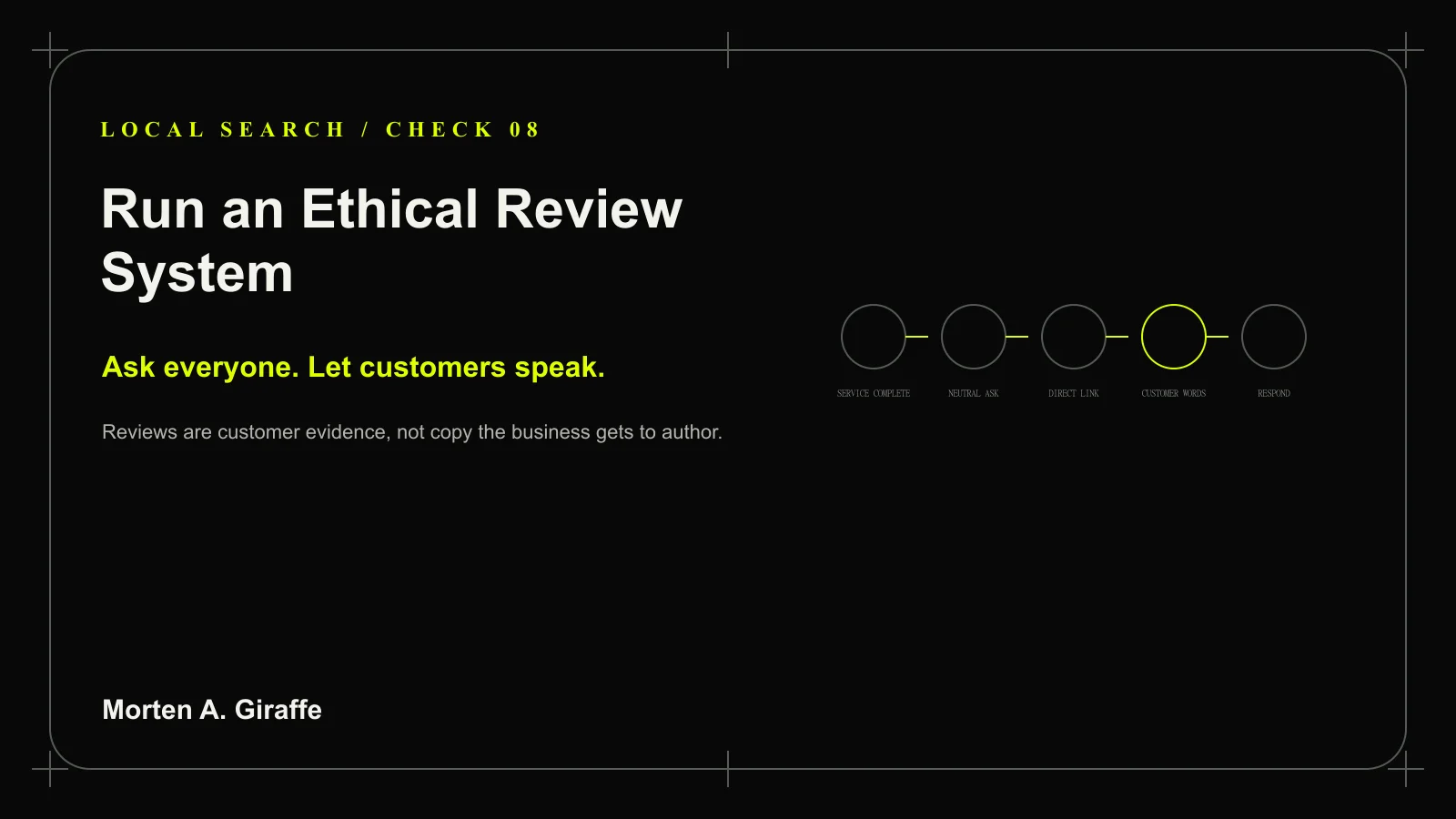 Check 08
Run an Ethical Review System
Ask everyone. Let customers speak.
Read the check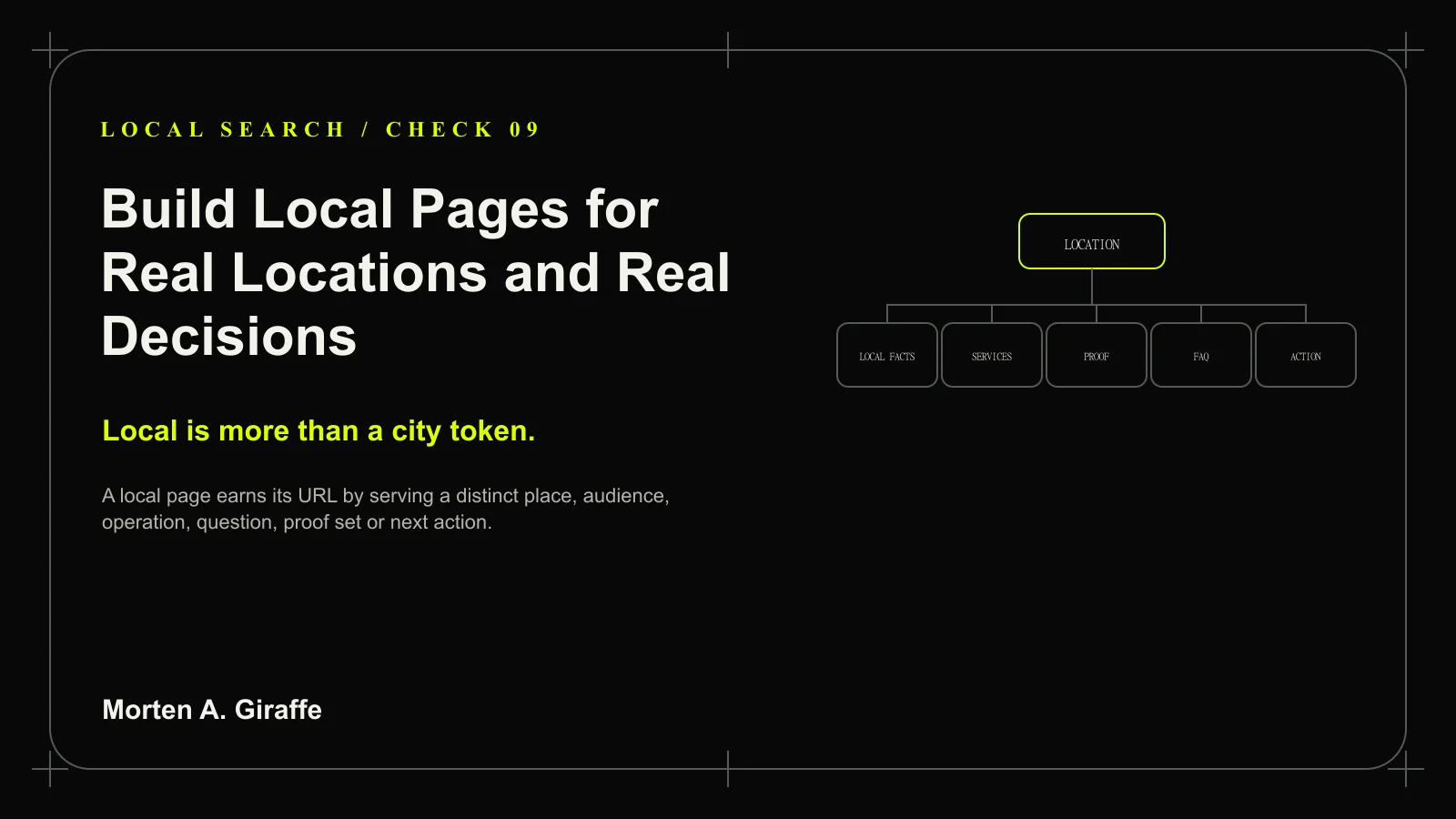 Check 09
Build Local Pages for Real Locations and Real Decisions
Local is more than a city token.
Read the check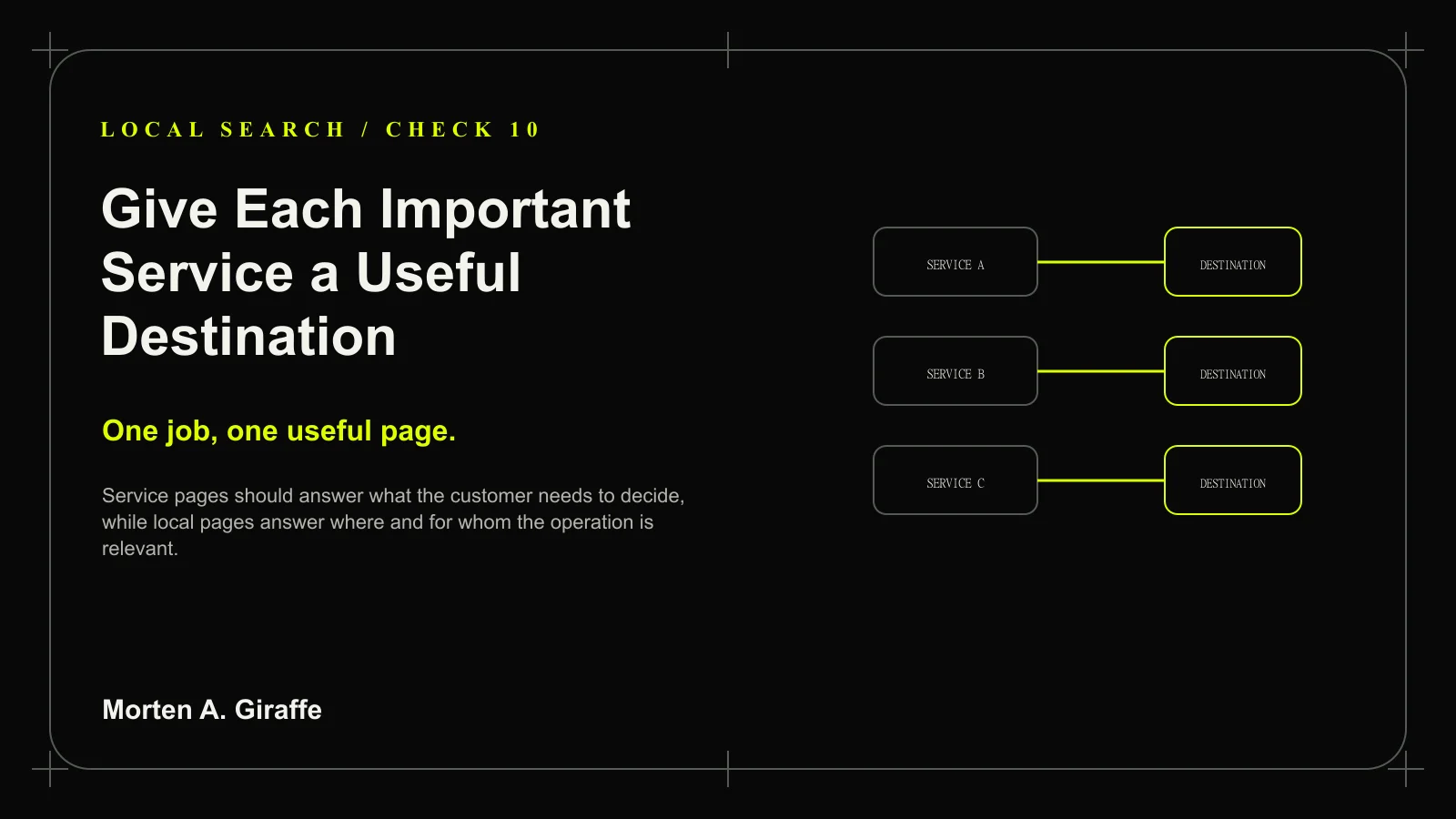 Check 10
Give Each Important Service a Useful Destination
One job, one useful page.
Read the check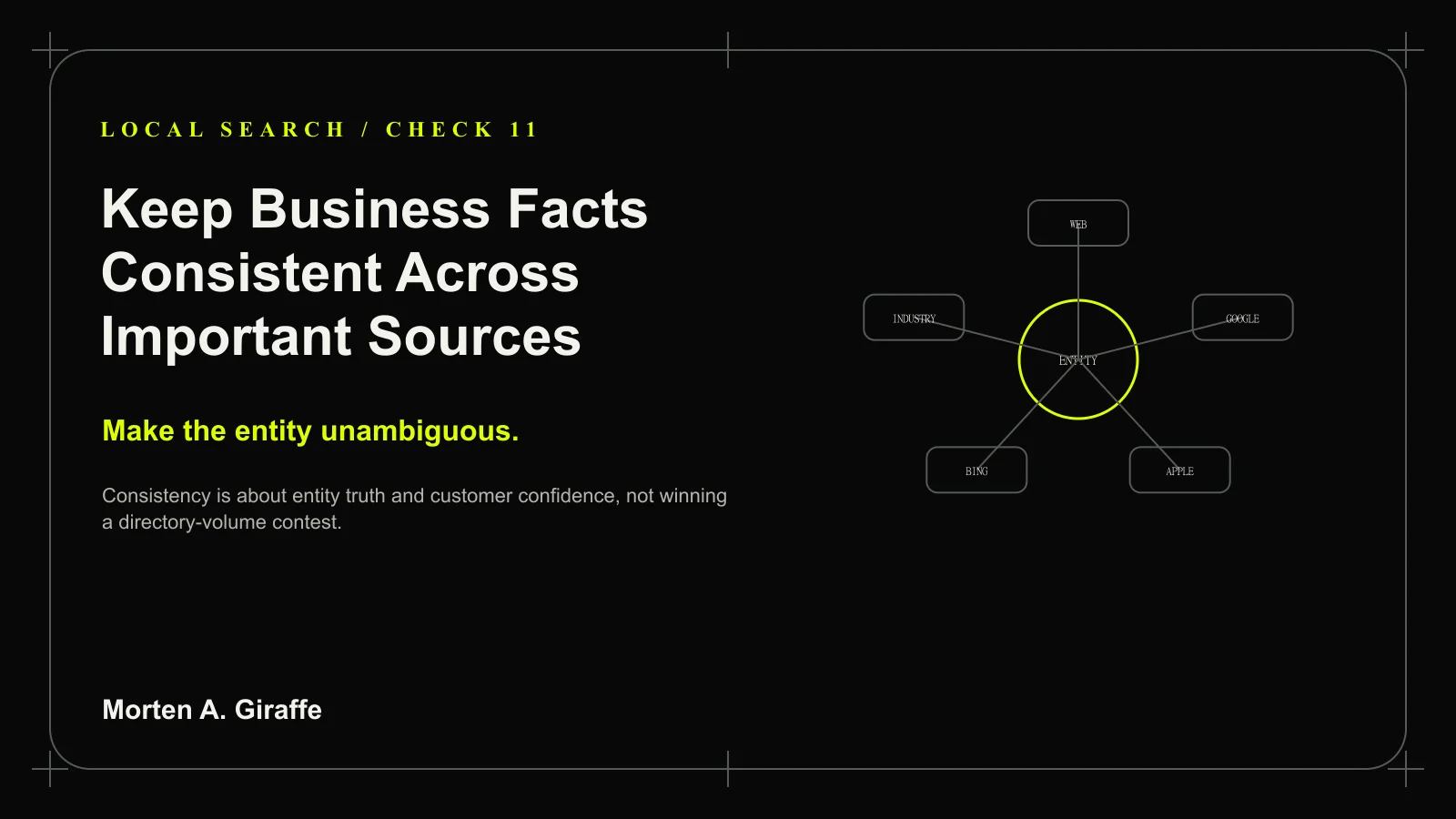 Check 11
Keep Business Facts Consistent Across Important Sources
Make the entity unambiguous.
Read the check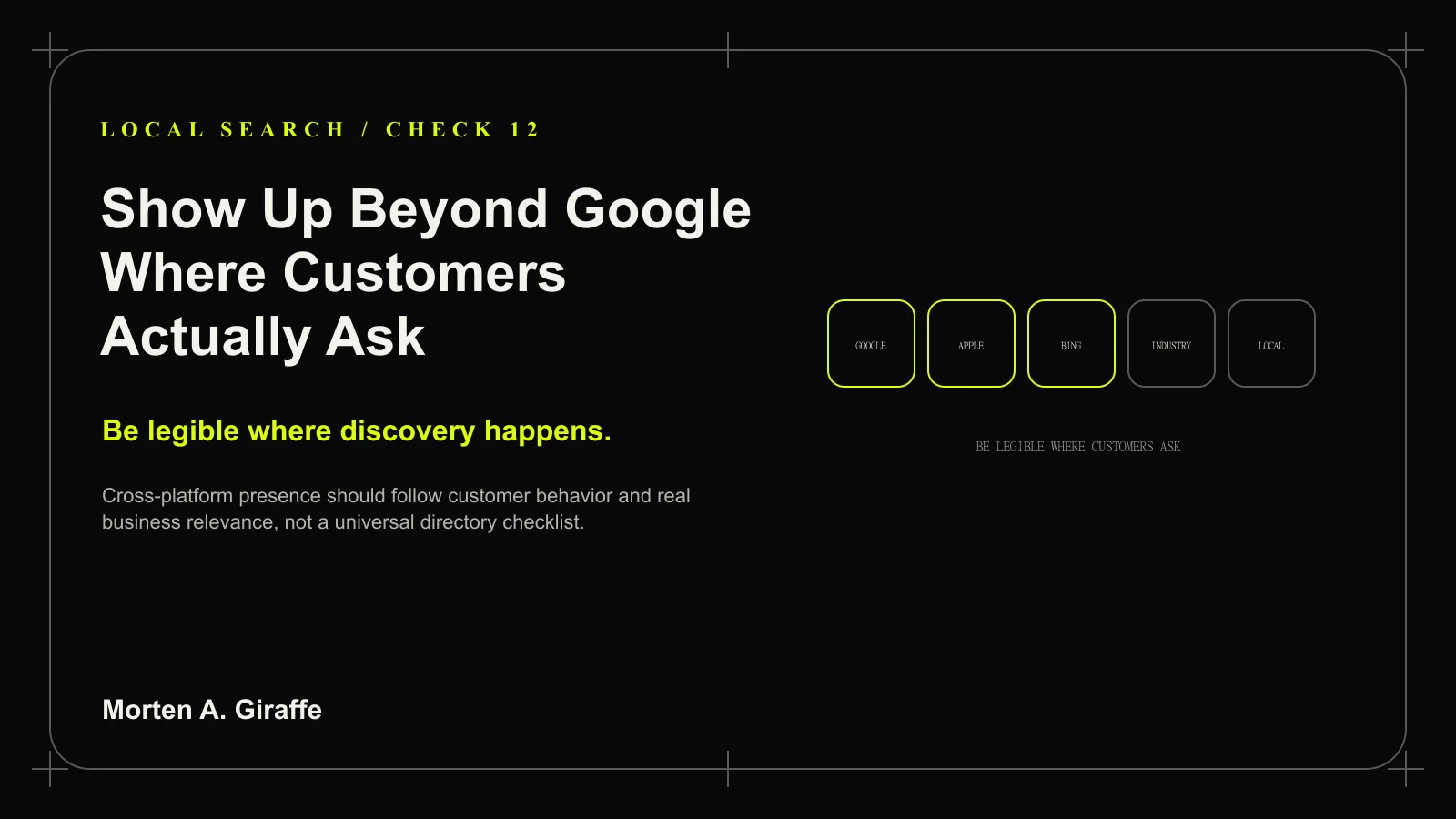 Check 12
Show Up Beyond Google Where Customers Actually Ask
Be legible where discovery happens.
Read the check
13–18 / Group 3
Keep it commercial and durable
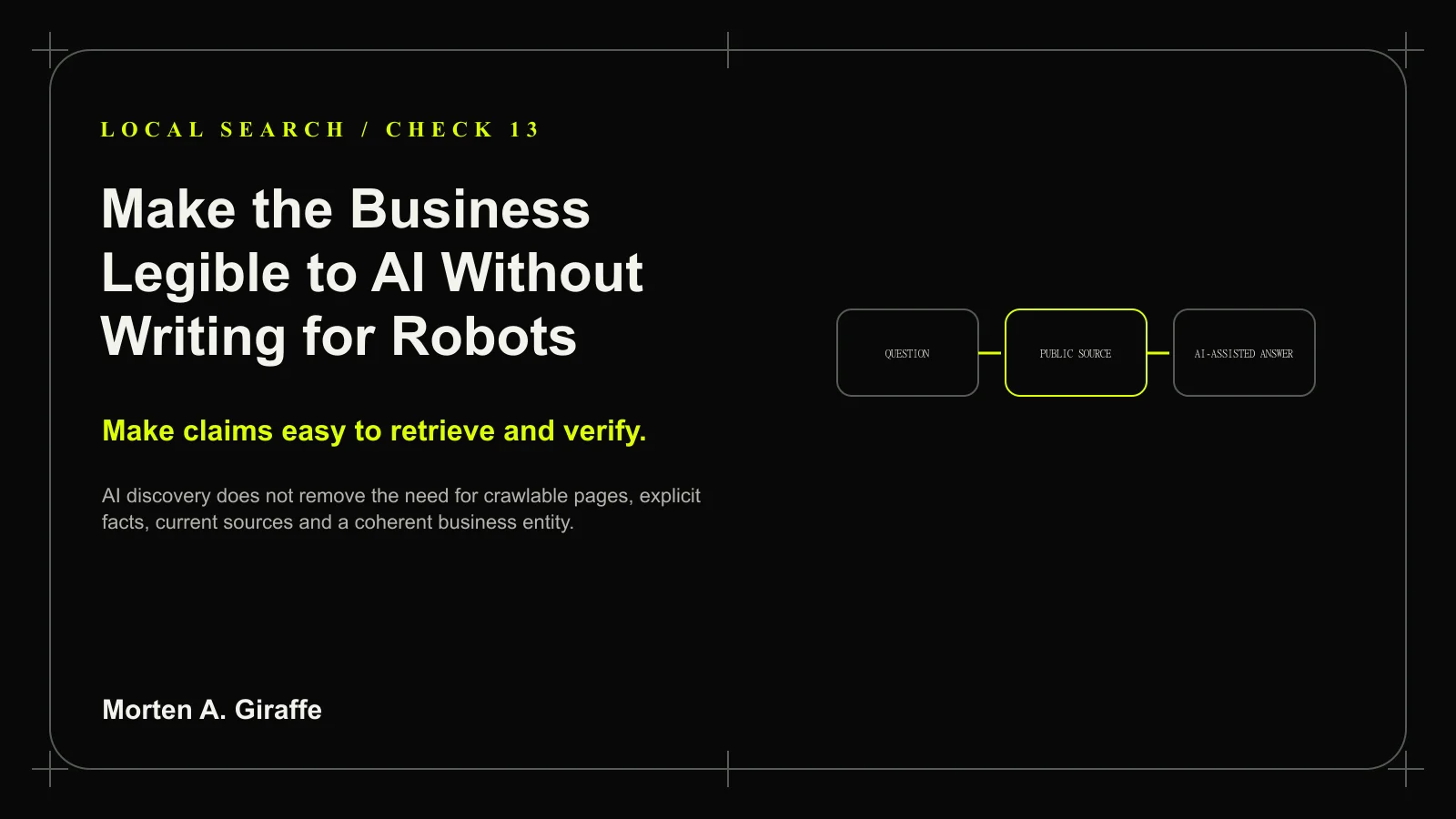 Check 13
Make the Business Legible to AI Without Writing for Robots
Make claims easy to retrieve and verify.
Read the check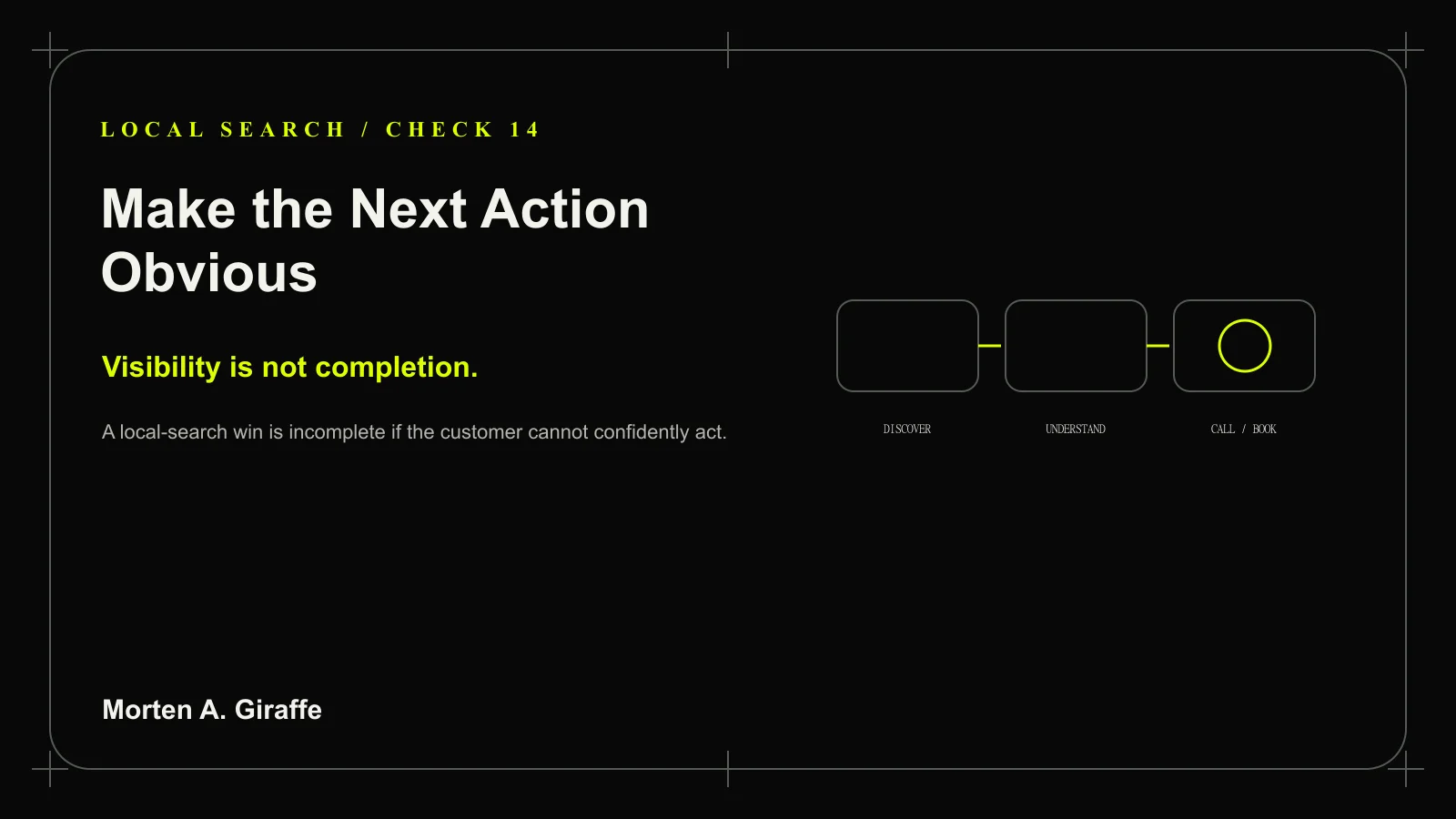 Check 14
Make the Next Action Obvious
Visibility is not completion.
Read the check Check 15
Remove Contact Friction After Discovery
Do not waste earned intent.
Read the check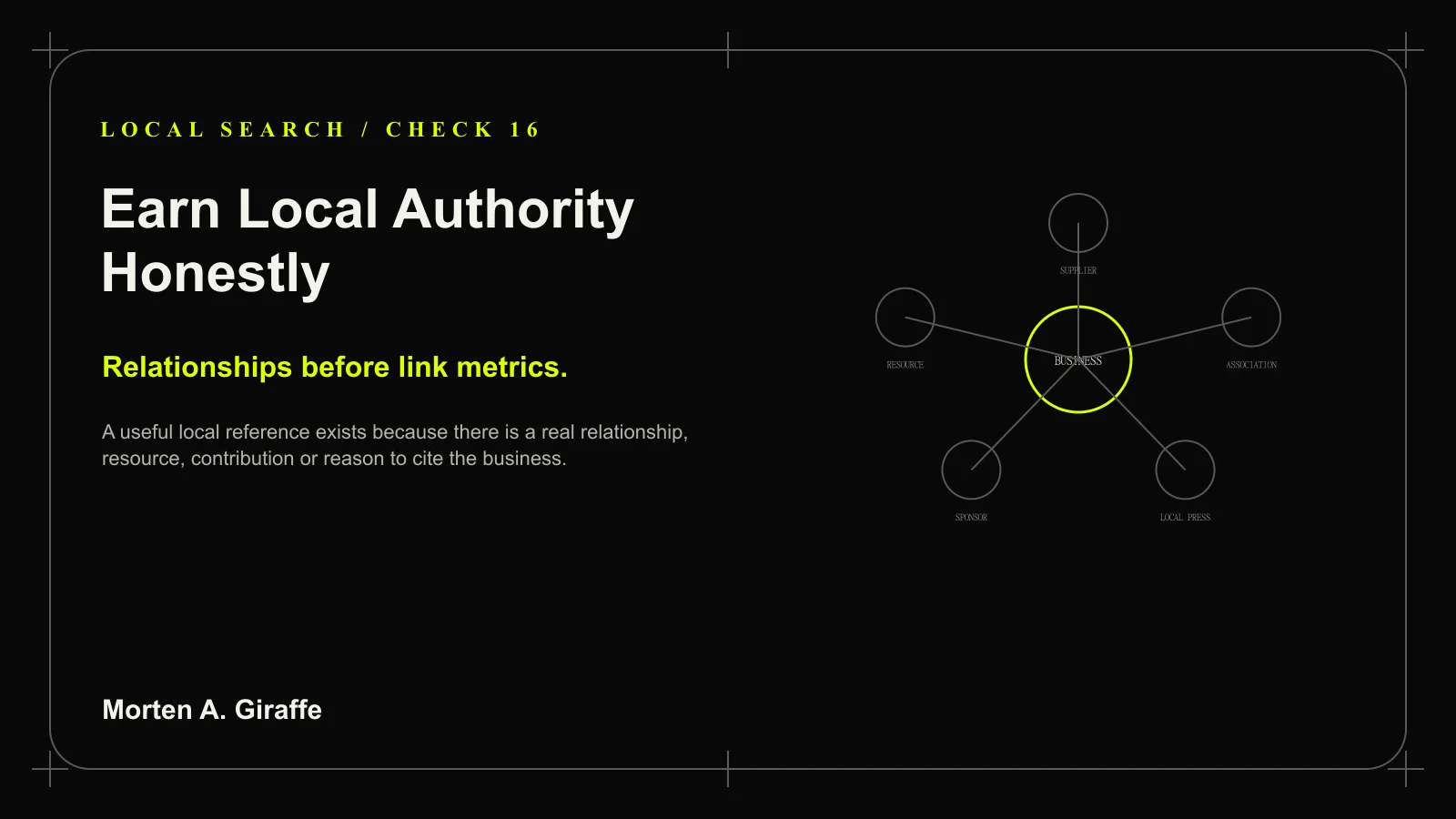 Check 16
Earn Local Authority Honestly
Relationships before link metrics.
Read the check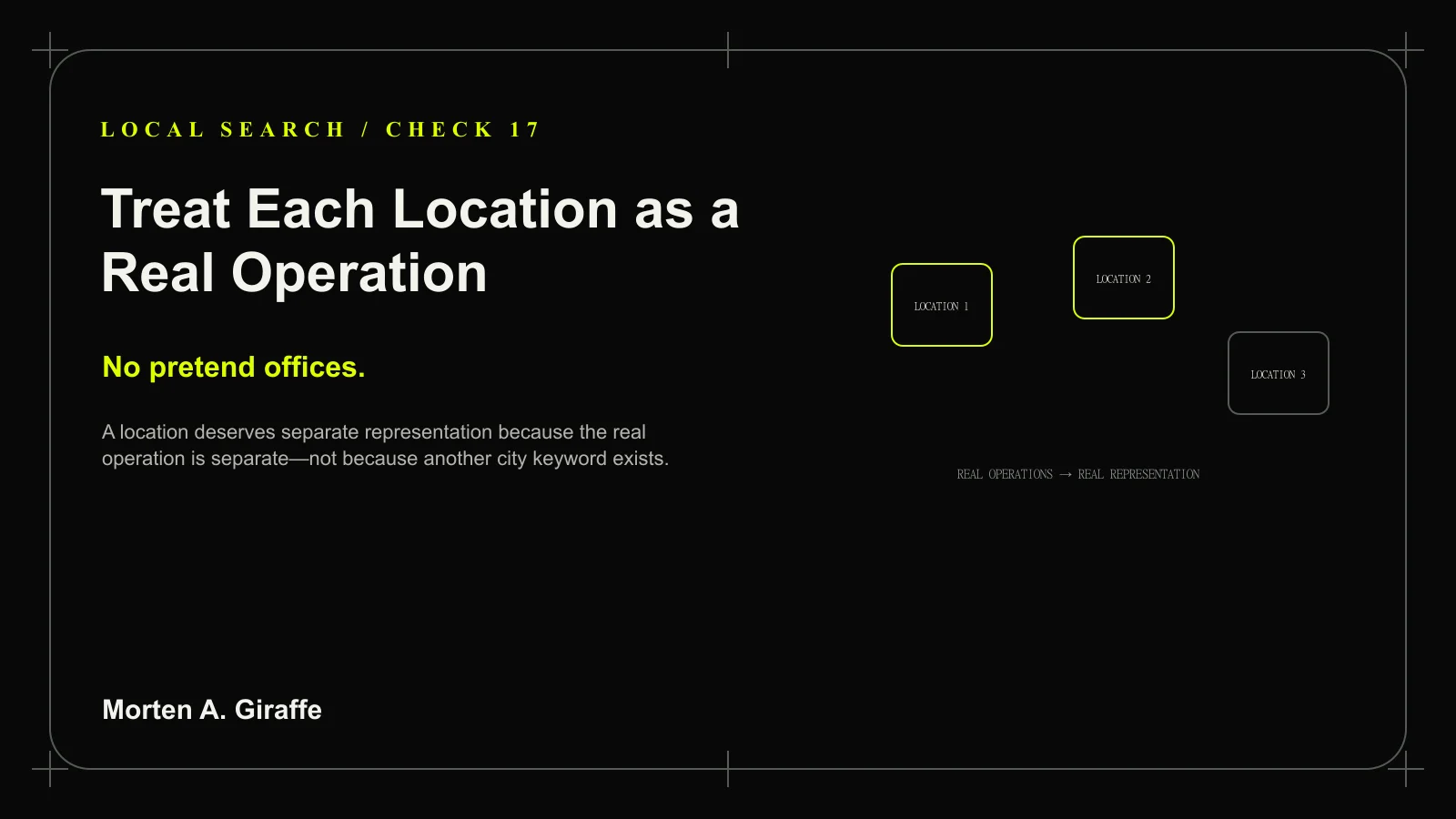 Check 17
Treat Each Location as a Real Operation
No pretend offices.
Read the check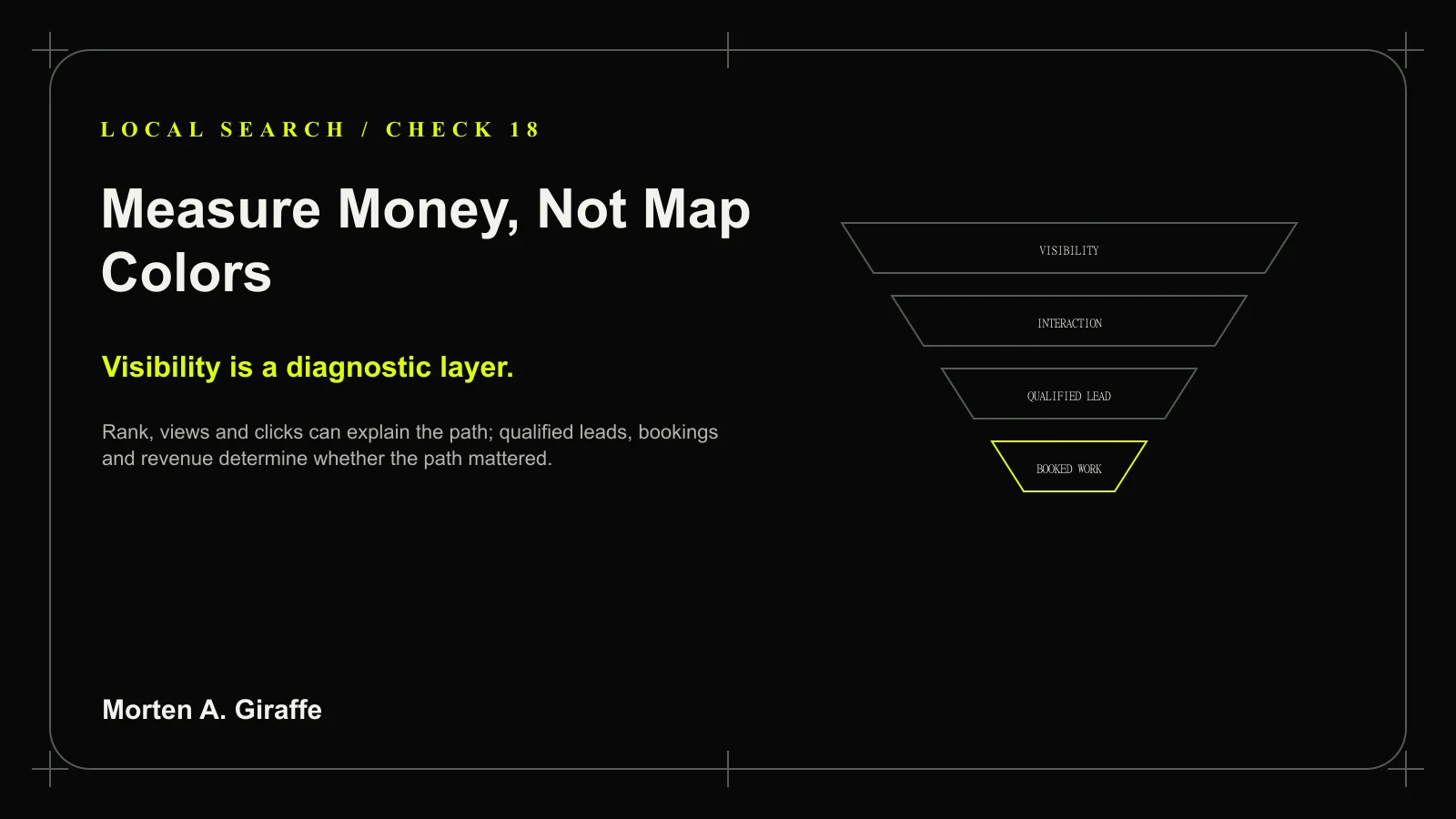 Check 18
Measure Money, Not Map Colors
Visibility is a diagnostic layer.
Read the check
The operating model
Work through the system once, then revisit the part that changed. An evidence gap should produce a clear next check, not an automatic purchase or a list of speculative fixes.
- 01Define
- Market, business, location, service, customer job and expected action.
- 02Verify
- Eligibility, ownership, profile facts, duplicates and current platform policy.
- 03Map
- Service → intent → profile → page → action → measurement.
- 04Make legible
- Useful pages, current facts, ethical reviews, structured relationships and relevant sources.
- 05Convert
- Phone, booking, form, directions, availability, mobile usability and failure recovery.
- 06Measure
- Visibility → interactions → website actions → qualified demand → business outcome.
- 07Protect
- Named owners, review cadence, release checks, metric definitions and a rollback path.
Get the working sheets
Nine editable worksheets and five CSV starters help turn the guide into a repeatable process. Read a worksheet here or download it. No email address is required. Files begin as blank working documents, not completed audit evidence.
Download the working kit · ZIP
Includes the nine Markdown worksheets, five CSV templates, check register, quick checklist, master prompt and 18 chapter prompts.
01Local Market Definition
Download Local Market Definition · Markdown
Do not begin with a keyword list.
Business
- Public business name:
- Business model: storefront / service-area / hybrid / practitioner / department / multi-location
- What the business actually sells:
- Primary business outcome:
- Primary customer types:
Legitimate locations / operations
| Location / operation | Type | Customer-facing? | Staffed? | Service area | Primary phone | Primary URL | Notes |
|---|
Service / customer jobs
| Customer problem | Actual service | Commercial importance | Geography | Urgency | Primary next action |
|---|
Representative search themes
Do not create every keyword variant. Define clusters that represent real decisions.
| Query / theme | Customer job | Service | Searcher geography | Intended profile/page | Why sample it |
|---|
Market boundaries
- Areas actually served:
- Areas not served:
- Travel / drive-time reality:
- Seasonal limits:
- Regulatory / licensing limits:
- Capacity limits:
Evidence gaps
- What is assumed?
- What needs owner confirmation?
- What needs platform verification?
02Local Business Entity Ledger
Download Local Business Entity Ledger · Markdown
One row per legitimate operation/location.
| Field | Expected truth | Website | Apple | Bing | Industry/local source | Conflict? | Owner | Last verified | |
|---|---|---|---|---|---|---|---|---|---|
| Public name | |||||||||
| Legal name if relevant | |||||||||
| Location type | |||||||||
| Address / hidden address | |||||||||
| Service area | |||||||||
| Phone | |||||||||
| URL | |||||||||
| Main hours | |||||||||
| Special hours process | |||||||||
| Primary category/type | |||||||||
| Verification/ownership | |||||||||
| Duplicate / old records |
Do not create new listings just to fill a blank. First determine whether the business is eligible and whether an existing record should be claimed, corrected, merged, moved or closed.
03Service → Intent → Destination Map
Download Service → Intent → Destination Map · Markdown
| Customer problem / intent | Actual service | Profile representation | Core service page | Relevant local page(s) | Primary CTA | Proof / trust needed | Measurement |
|---|
Rules
- Consolidate synonyms.
- Do not create a page for every phrase.
- Service pages answer what / why / how / fit.
- Local pages answer where / local operation / local proof / local action.
- The destination should reduce uncertainty, not merely contain the keyword.
04Local Visibility Sampling Sheet
Download Local Visibility Sampling Sheet · Markdown
Every observation needs context.
| Date/time | Query / service | Searcher location / sample point | Tool / manual method | Surface | Observed result | Destination | Notes / limits |
|---|
Comparison method
- Query set:
- Geography / radius:
- Sample density:
- Tool / settings:
- Device/context:
- Cadence:
- Known limitations:
Interpretation
What pattern changed?
What did not?
What customer/business outcome changed in the same period?
What else changed?
What evidence is missing?
Never label this sheet “our ranking.” It is a defined sample.
05Ethical Review System
Download Ethical Review System · Markdown
Expected flow
Completed genuine customer interaction
→ neutral review request
→ direct platform link / QR where appropriate
→ customer chooses whether to review
→ customer controls rating and words
→ business responds
→ recurring service themes feed operations/content
Audit
- Trigger:
- Who receives the request:
- Who is excluded and why:
- Request wording:
- Incentive offered?:
- Review gating / sentiment screening?:
- Staff quota?:
- Requested rating or wording?:
- Direct link / QR:
- Follow-up cadence:
- Response owner:
- Escalation for service recovery:
- Qualitative themes recorded:
Neutral request example
“Thanks for choosing [Business]. If you’d like to share your experience, you can leave a review here: [direct link].”
Do not condition the request on satisfaction, offer a reward, demand a rating, or tell the customer what to mention.
06Local Page Brief
Download Local Page Brief · Markdown
Page job
This page helps [specific local visitor] understand/do [specific thing] so they can [next action].
Why this URL deserves to exist
- Real location / service area:
- Distinct audience or customer situation:
- Distinct operational facts:
- Distinct proof:
- Distinct questions:
- Distinct action:
- What would be lost if merged with another page?
Required visible facts
- Business/location name:
- Address or service-area treatment:
- Local phone:
- Hours:
- Services actually available:
- Service limitations:
- Primary CTA:
- Response / arrival expectations:
Useful local context
Only include what helps the customer:
- service coverage;
- parking/access;
- directions/landmarks;
- courthouse/venue/territory context;
- local regulations;
- location-specific team/operation;
- real project/case evidence;
- location-specific FAQs.
Relationship to service pages
| Service | Core service URL | Why linked here | Local note |
|---|
SEO / technical
- Intended index state:
- Canonical:
- H1:
- Title promise:
- Internal links:
- Structured data:
- Image alt/context:
- Sitemap:
- Redirect/history issues:
Reject the page if
The only meaningful difference is swapping the place name.
07Multi-Location Truth Matrix
Download Multi-Location Truth Matrix · Markdown
| Location | Real operation? | Eligibility verified? | Customer-facing? | Staff / service responsibility | Service area | Phone | URL | Hours | Profile | Page | Reviews / proof | Lead routing |
|---|
Questions
- Which facts are brand-wide?
- Which facts are location-specific?
- Which categories should be consistent?
- Which services genuinely differ?
- Are any profiles virtual, duplicate, former or unsupported?
- Does each page lead to the correct operation?
- Can analytics/CRM distinguish locations without exposing customer data?
08Local Search Measurement Plan
Download Local Search Measurement Plan · Markdown
Expected change
What are we changing and why?
User outcome
What should become easier for the nearby customer?
Business outcome
What commercial outcome matters?
Measurement stack
| Layer | Question | Metric / observation | Source | Baseline | Cadence | Caveat |
|---|---|---|---|---|---|---|
| Visibility | Are we being discovered in the defined market? | sample, not universal rank | ||||
| Profile | Are customers interacting? | platform metric definition | ||||
| Website | Are they reaching and using the intended destination? | tracking/consent | ||||
| Lead | Are actions becoming qualified demand? | source matching | ||||
| Business | Is demand becoming booked work/revenue? | attribution limits | ||||
| Guardrail | What must not worsen? |
Review
- What improved?
- What worsened?
- What stayed flat?
- What else changed?
- What is still unverified?
- Decision: KEEP / REVISE / REVERSE
09Monthly Local Search Review
Download Monthly Local Search Review · Markdown
Facts
- Verify unexpected profile changes.
- Verify main/special hours.
- Verify phone / URL / primary action links.
- Review duplicates / moves / closures if anything changed.
- Check major cross-platform contradictions.
Visibility
- Repeat the same defined query/geography samples.
- Record methodology and limitations.
- Compare patterns, not just one color/average.
Reviews
- Check that the request system remains neutral and policy-safe.
- Review recent genuine feedback themes.
- Respond appropriately where the business chooses to respond.
Website
- Review important local/service landing pages.
- Check internal links.
- Test primary mobile call/form/booking paths.
- Check errors, performance and accessibility regressions.
Outcomes
- Compare profile interactions.
- Compare calls/forms/bookings.
- Compare qualified leads / booked work where available.
- Note seasonality, media spend, staffing, pricing or major changes.
Decision
- Keep:
- Revise:
- Stop:
- Investigate:
- Evidence needed:
CSV starters
The bounded local-search audit prompt
Give your agent the real business, intended market and evidence you are authorized to share. This prompt starts read-only and separates platform policy, observations, hypotheses and unknowns. Do not include credentials or private customer records.
Read the full prompt
You are conducting a bounded local-search audit of a real business.

AUTHORITY
Start with the user's instructions, the business's verified facts, and current first-party platform documentation. Use the Morten A. Giraffe Local Search Field Guide as workflow/reference material. Do not invent platform behavior, rankings, customers, reviews, results, eligibility, revenue or attribution.

BEGIN READ-ONLY
Do not change Business Profiles, listings, websites, analytics, review systems, call tracking, customer records, domains or production configuration until the evidence, plan, required access and rollback/verification method are explicit.

1. DEFINE THE EXPECTED STATE
State:
- real business/entity;
- business model: storefront / service-area / hybrid / practitioner / department / multi-location;
- legitimate locations/service areas;
- primary services and customer problems;
- market/geography;
- intended profile/page destination;
- primary next action;
- business outcome;
- evidence required.

2. ESTABLISH THE BASELINE
Collect what is safely available:
- verification/profile state;
- business facts;
- representative local-visibility samples;
- Business Profile interactions;
- website landing/conversion data;
- calls/forms/bookings;
- qualified leads/booked work where available;
- reviews;
- concurrent campaigns/seasonality/operational changes.
Record dates, sources, metric definitions and gaps.

3. VERIFY THE ENTITY
Check:
- eligibility and ownership;
- real-world name;
- storefront vs service-area/hybrid rules;
- address/service area;
- phone;
- website destination;
- hours;
- duplicates/moves/closures;
- multi-location legitimacy.

4. REVIEW CATEGORIES + SERVICES
Use categories to describe what the business IS.
Map customer problems to actual services, profile representation, website destinations and next actions.
Do not treat categories or services as keyword-stuffing fields.

5. SAMPLE VISIBILITY RESPONSIBLY
For each observation record:
query/service · searcher location · date/time · tool/method · result surface · observed position/state · destination · limitations.
Use consistent samples for comparison.
Never describe one point or grid as the universal ranking.

6. AUDIT PROFILE INFORMATION
Check verification, business facts, categories, service area, phone, URL, hours/special hours, description, services/products, attributes, action/business links and authorized media.
Prioritize customer usefulness and current policy.

7. AUDIT REVIEWS
Check request trigger, eligible audience, wording, direct link/QR flow, incentives, gating, quotas, requested rating/content, response process and qualitative feedback.
Use current review policy.
Do not recommend incentives, selective positive solicitation or scripted customer sentiment.

8. AUDIT WEBSITE ARCHITECTURE
Check:
- whether each real location page has a distinct page job;
- whether each important service has a useful destination;
- service ↔ location internal linking;
- local facts and proof;
- contact/action clarity;
- reliable HTML;
- metadata/canonical/indexability;
- LocalBusiness/Organization structured data only when it describes visible truth.
Do not generate doorway-style city substitutions.

9. CHECK ENTITY CONSISTENCY + DISCOVERY SOURCES
Compare visible business facts across the website, Google, Apple, Bing and only the industry/local sources relevant to the business.
Prioritize contradictions and authoritative/customer-used sources over citation volume.

10. CHECK AI-SEARCH LEGIBILITY
Identify common local customer questions and the exact public source that supports each answer.
Check explicit facts, page structure, crawl/render eligibility, sourceability, current dates and entity relationships.
Do not promise AI citations or recommendations.

11. TRACE SEARCH → ACTION
From a realistic mobile discovery path, verify:
profile/result → landing page → call/book/form/directions → confirmation/response.
Check friction, performance, accessibility, validation, error recovery and correct location/service routing.

12. REVIEW LOCAL AUTHORITY
Inventory real suppliers, partners, associations, licensing sources, local organizations, sponsorships, publications, useful resources and legitimate reference opportunities.
Do not recommend manipulative link schemes or metric-only buying.

13. REVIEW MULTI-LOCATION TRUTH
For every location/profile/page, verify:
real operation · eligibility · staffing/customer-facing status · service area · phone · URL · hours · category/name consistency · lead routing · reviews.
No virtual/pretend offices.

14. MEASURE COMMERCIAL OUTCOMES
Build the path:
visibility → profile interaction → website action → qualified lead → booking/job/revenue where appropriate.
State attribution limitations and concurrent changes.
End with keep / revise / reverse decisions.

FINDING FORMAT
For each finding include:
ID · check · business/location/market · platform/route · severity · confidence · classification · expected vs actual · reproduction/evidence · root cause or labeled hypothesis · smallest correction · acceptance/retest · owner · cadence · remaining unknowns.

CLASSIFICATIONS
Confirmed defect · policy risk · suspected risk · UX friction · incomplete capability · documentation/data drift · measurement gap · evidence gap.

DO NOT
- promise #1 rankings;
- invent benchmark review counts;
- invent click-share percentages;
- treat a grid as the market;
- manufacture local pages;
- create fake locations;
- keyword-stuff business names/categories;
- gate or incentivize reviews;
- fabricate testimonials or local proof;
- equate rank movement with revenue;
- claim an AI system will cite/recommend the business;
- modify production without authorization.

DELIVERABLES
1. Executive local-search verdict.
2. Business/market/entity baseline.
3. 18-check coverage matrix.
4. Ranked findings.
5. Service-intent map.
6. Profile/entity consistency issues.
7. Local page/service architecture recommendations.
8. Review-system assessment.
9. Search-to-action friction findings.
10. Cross-platform/AI-discovery gaps.
11. Measurement plan.
12. Today / next 30 days / later priorities.
13. Exact evidence gaps and safe next checks.

Finish with the three highest-value actions that improve customer understanding, legitimate discoverability or qualified outcomes—not merely dashboard scores.A routine, not a campaign
Weekly
- Check unexpected profile edits, factual errors, closures and special hours.
- Respond appropriately to genuine reviews.
- Check that important contact paths still work; update information when something actually changed.
Monthly
- Repeat the same visibility samples and compare the same metric definitions.
- Review calls, forms, bookings, lead quality and important landing pages.
- Reconcile listing contradictions, recurring customer questions and concurrent changes.
Quarterly
- Revalidate market, services and location eligibility.
- Review page overlap, missing customer decisions and legitimate local relationships.
- Revisit measurement limits and decide what to keep, revise or stop.
After a move, rebrand, acquisition, phone or domain change, or a location opening or closure, establish a new baseline for the affected operation before comparing periods.
Use AI without outsourcing judgment
A useful agent names what it is auditing, checks current official sources, collects evidence before editing and verifies the customer path afterward. It should state confidence separately from severity and distinguish policy from recommendation.
AI should never be the only source for whether a location is real, a review is genuine, a profile is eligible or a call became revenue. Keep an owner beside each finding and an acceptance test beside each proposed correction.
Apply the framework
Bring me the problem.
Bring your website, legitimate locations or service areas, primary services and the market you care about. We can start with the evidence you can safely share and work out which change is worth making.
Discuss the workQuestions worth asking
Is local SEO just Google Business Profile optimization?
The profile matters, but the journey also depends on the real business, geographic context, useful website pages, reviews, external sources, the action path and measurement.
How many reviews or citations do I need?
There is no universal quota in this guide. Compare the real market and maintain accurate representation on important customer-used platforms. A competitor count is not a policy or a guarantee.
Should every nearby city have a page?
No. A page should serve a distinct audience, place, operation, question, proof set or next action. City-name substitution alone does not give a page a useful job.
Do rank grids matter?
They can be useful samples when the query, geography, tool settings and cadence are documented. They are not the entire market. Interpret them alongside customer and business outcomes.
Can an AI assistant recommend my business?
AI-assisted local discovery exists, including Google’s Ask Maps. Clear, current and sourceable information can support discovery, but this guide cannot promise selection, citation or recommendation.
How do I know whether the work is profitable?
Define the path from visibility through interactions to qualified leads and booked work. Preserve measurement gaps, concurrent changes and attribution caveats. Do not equate a ranking change with revenue.
Can I incentivize Google reviews?
Google prohibits incentivized reviews, discouraging negative reviews and selectively soliciting positive reviews. Use neutral requests to genuine customers. Read Google’s contribution policy.
Sources and interpretation
Platform sources checked . Features and eligibility can change. Recheck the relevant source before making an account change. The operating model, worksheets and field tests are Morten’s recommendations, not a platform certification.
- Google: improve your local rankingFirst-party platform documentation
- Google: represent your business accuratelyFirst-party platform documentation
- Google: Business Profile eligibility and ownershipFirst-party platform documentation
- Google: service-area and hybrid businessesFirst-party platform documentation
- Google: edit your Business ProfileFirst-party platform documentation
- Google: understand Business Profile performanceFirst-party platform documentation
- Google Maps: prohibited and restricted contentFirst-party platform documentation
- Google: tips to get more reviewsFirst-party platform documentation
- Google: manage business linksFirst-party platform documentation
- Google Search: LocalBusiness structured dataFirst-party platform documentation
- Google: Ask Maps and immersive navigationFirst-party platform documentation
- Apple Business: manage your presenceFirst-party platform documentation
- Microsoft: add and manage your business listingFirst-party platform documentation
- Morten: UI/UX Field GuideMorten workflow and interpretation
- Morten: Technical SEO Field GuideMorten workflow and interpretation
- Morten: Product Audit Field GuideMorten workflow and interpretation
Keep the rest of the path working
- Technical SEO — make local and service pages reachable, understandable and durable.
- UI/UX Field Guide — keep the landing and action path usable.
- Product Audit — separate working behavior from assumptions.
- Website Launch Checklist — verify the release after implementing a correction.