
06 / Establish the local truth
Sample Geography Carefully: A Grid Is Evidence, Not the Market
This check helps an analyst use geographic rank observations responsibly without presenting one scan, one device, or one tool as universal truth.
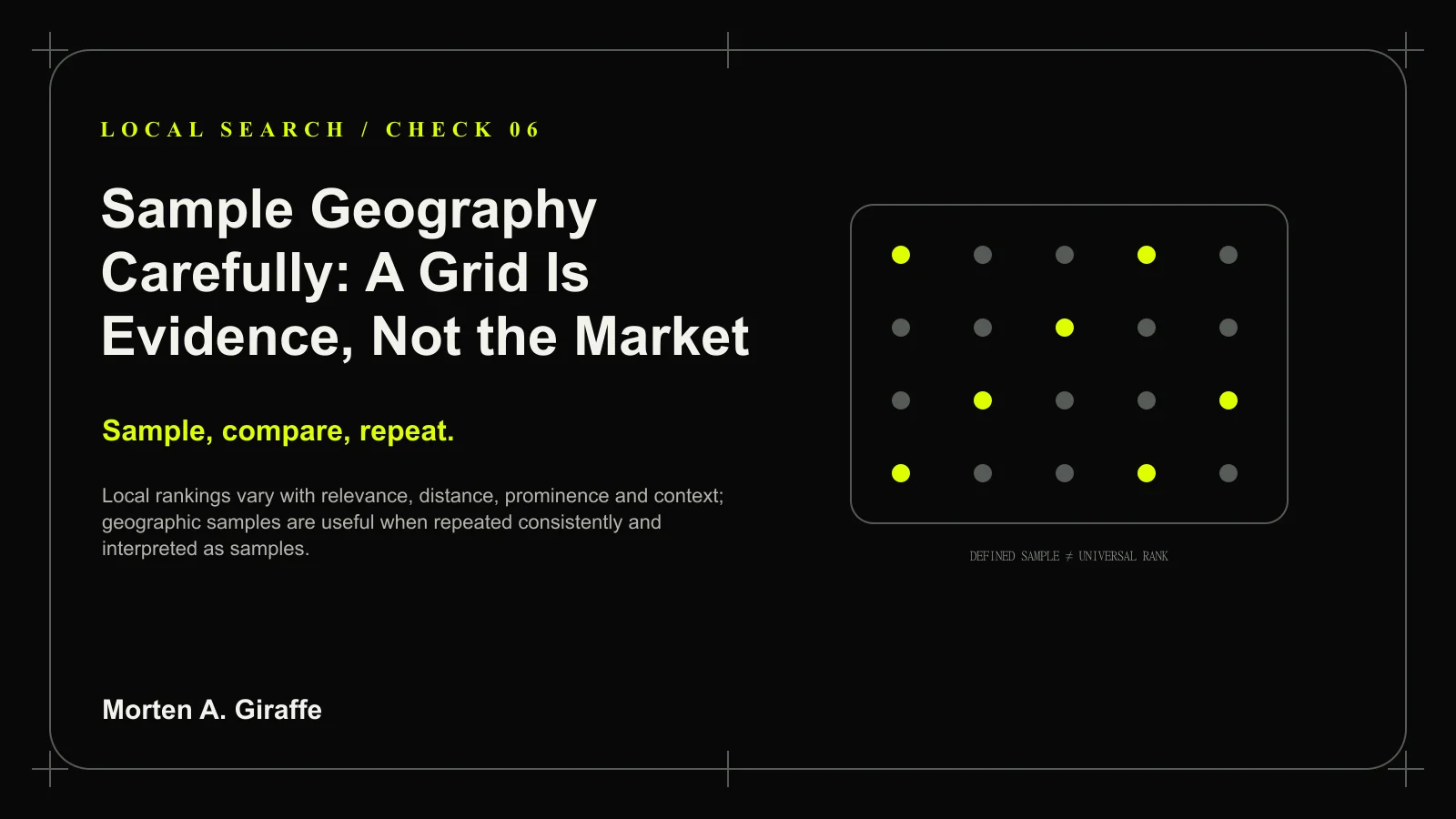
Sample, compare, repeat. Local rankings vary with relevance, distance, prominence and context; geographic samples are useful when repeated consistently and interpreted as samples.
Scenario
Illustrative scenario · not a client result
A bright rank grid turns mostly green after a campaign, so the team declares market dominance. The grid only covered one query, one time, one tool, and one radius; calls did not change. The visualization looked conclusive because its limitations were hidden.
Evidence Lab
Collect the minimum evidence needed to answer this check. Keep the date, location, platform, route, role and source beside the observation.
- 01
Defined query/service group from Check 01.
- 02
Repeatable sample locations tied to the real customer market.
- 03
Tool/manual method, date, time, device/context where known, and settings.
- 04
Observed local-pack/map results plus landing/profile destination.
- 05
Business outcomes for the same period when available.
A manual search, profile screenshot, rank-grid point, website event and booked job are different kinds of evidence. Keep their definitions separate.
Principle
Local rankings vary with relevance, distance, prominence and context; geographic samples are useful when repeated consistently and interpreted as samples.
The job is to help customers discover, understand, choose and contact the real business, then verify what happened. This field test is workflow guidance; it is not a claim that each action is a ranking factor.
Rebuild
- Use the same query, sample locations, tool/settings and approximate cadence when comparing over time.
- Keep radius/density appropriate to the actual market instead of maximizing points.
- Store raw observations and summary interpretation separately.
- Compare multiple commercially meaningful services rather than one vanity query.
- Treat changes as diagnostic signals to investigate alongside profile, website and business outcomes.
Before editing a Business Profile, confirm the current platform requirements in the source trail. Keep the proposed change within the business’s actual operation and your account authority.
Field Test
The test
Repeat the same geographic sample twice under documented conditions. Confirm the report can explain what each point means, what it does not mean, and why the chosen geography represents real customers.
Record the result honestly
Verified pass · Verified fail · Partial · Not tested · Blocked · Not applicable
A pass needs reproducible evidence. If access, a definition or permission is missing, name the gap and the next person who can resolve it. Missing evidence never becomes a pass by default.
Use by role
- Analyst
- Owns methodology and limitations.
- Owner
- Confirms sample geography matches real operations.
- SEO
- Uses patterns to choose investigations rather than claim universal rank.
- Sales / operations
- Checks whether visibility changes align with qualified demand.
Checklist
Use these as reading markers. They stay in this page session and are not submitted, saved as an audit or sent to analytics.
Ask Your AI
Give the agent your expected state, relevant business facts and safe evidence. Keep secrets and private customer data out. Start read-only; account and production changes require their own authorization.
Read the full prompt
You are conducting a bounded local-search investigation for CHECK 06: SAMPLE GEOGRAPHY CAREFULLY.

PAGE / BUSINESS JOB
This check helps an analyst use geographic rank observations responsibly without presenting one scan, one device, or one tool as universal truth.

EXPECTED STATE
State what should be true for this business, location, market and platform before proposing changes.

EVIDENCE
Collect current, reproducible evidence. Tie it to date, location, query/service, platform/surface, page/profile, and source. Separate platform policy, observed behavior, inference, hypothesis and unknown.

SPECIFIC CHECK
Design a repeatable local-visibility sampling plan. Specify query group, sample geography, tool/manual method, density/radius, cadence, environment details and limitations. Treat each point as an observation, compare patterns over time, and connect findings to customer/lead evidence. Never invent rank data or universalize a grid.

MORTEN A. GIRAFFE WORKING RULES
- Evidence before advice.
- The map is not the market.
- A local ranking observation is not a universal rank.
- A profile field is not permission to keyword-stuff.
- A review is customer evidence, not copy the business controls.
- A location is real because the operation is real.
- A local page earns its URL by serving a distinct audience, place, question, proof set or next action.
- Visibility is diagnostic; qualified demand and business outcomes determine whether the work mattered.
- Correlation is not clean attribution.
- Do not invent proof, rankings, review counts, customer data, testimonials, revenue, eligibility or platform behavior.

SAFETY / AUTHORITY
Begin read-only unless the user explicitly authorizes changes. Do not alter Business Profiles, listings, domains, analytics, production pages, review requests, customer records or tracking without the required account authority and a rollback/verification plan.

OUTPUT
For each finding report:
ID · market/location · platform/route · severity · confidence · classification · expected vs actual · evidence · root cause or labeled hypothesis · smallest recommendation · acceptance/retest · remaining unknowns.

Finish with the three highest-value next actions, not a generic SEO task list.

Reference:
https://www.mortenagiraffe.com/journal/local-search-field-guideVerify the result
- Did the evidence come from the intended business, location and market?
- Is every current platform claim tied to an official source?
- Are the recommendation, observed facts and untested hypothesis distinguishable?
- Are profile and website facts still consistent?
- Did the correction introduce an eligibility, review-policy, accessibility, routing or measurement problem?
- What observation would disprove the recommendation?
Questions
Is this check a ranking factor?
Not every useful practice is a ranking factor. This check addresses the business baseline, representation or geographic evidence. Use the cited platform documentation for platform claims and the field test for practical verification.
Does passing guarantee visibility?
No. Local search is competitive and contextual. Google describes relevance, distance and how well-known the business is; a checklist cannot guarantee a position. Google’s local-ranking guidance explains that framework.
What if part of the test is unavailable?
Record Not tested, Blocked or Partial and state the exact access, evidence or authorization needed. Continue independent checks that can be completed safely.
Source trail
Platform sources checked . Recheck policy before acting. Illustrations and scenarios teach the method; they do not show measured client outcomes.
- Google: improve your local rankingFirst-party platform documentation