
13 / Keep it commercial and durable
Make the Business Legible to AI Without Writing for Robots
This check helps a business publish clear, sourceable local facts and answers that work for people first and are also technically eligible for retrieval by AI-assisted discovery systems.
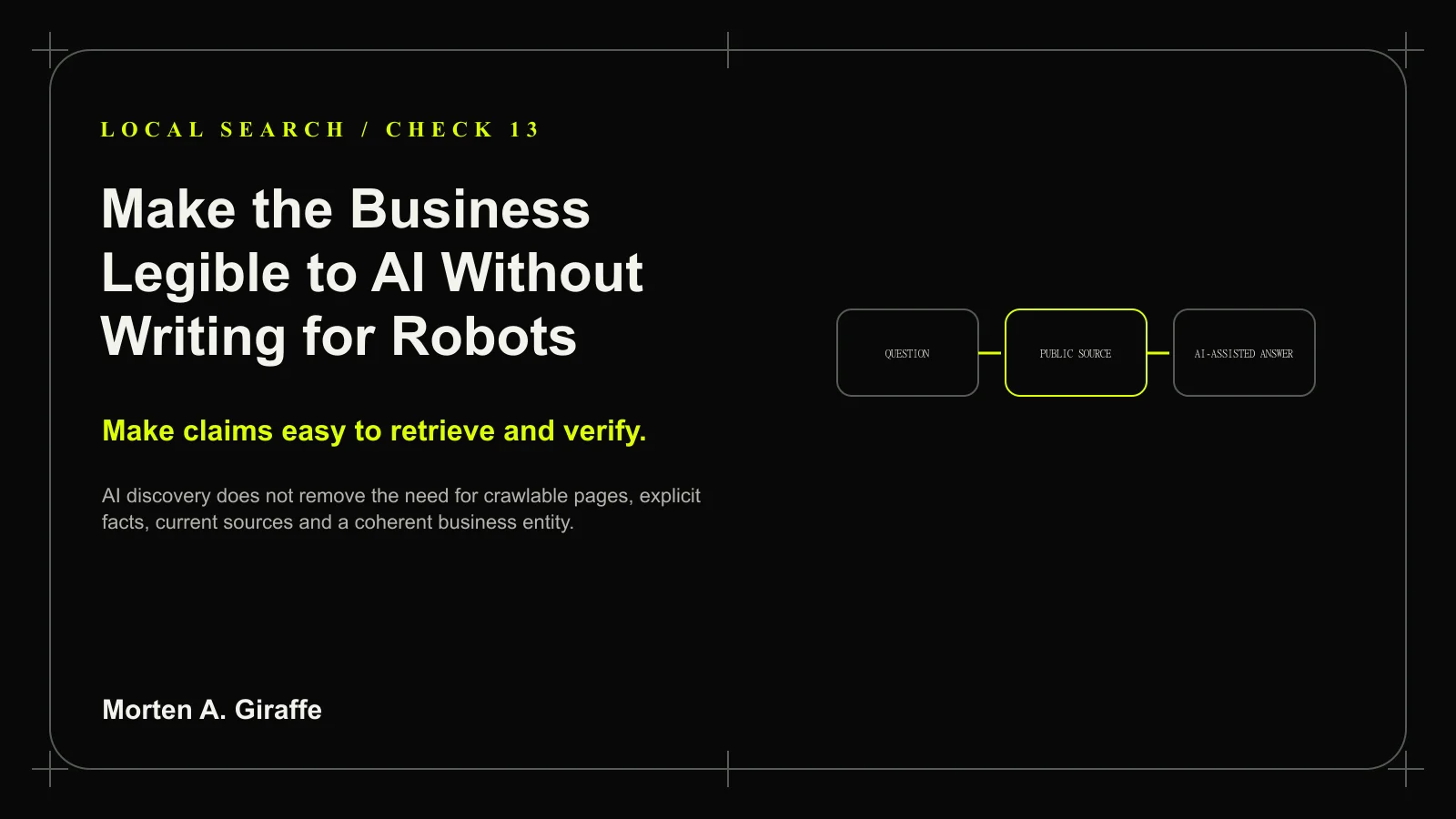
Make claims easy to retrieve and verify. AI discovery does not remove the need for crawlable pages, explicit facts, current sources and a coherent business entity.
Scenario
Illustrative scenario · not a client result
A business adds “AI SEO” paragraphs full of vague claims while its locations, services, hours and proof remain scattered. The content sounds optimized for a machine but gives neither the customer nor the machine a stable answer.
Evidence Lab
Collect the minimum evidence needed to answer this check. Keep the date, location, platform, route, role and source beside the observation.
- 01
Clear visible statements of who the business is, what it does, where it operates and how to contact it.
- 02
Useful service/location pages with explicit headings and answers.
- 03
Current business facts across major map/listing systems.
- 04
Structured data that describes visible content where appropriate.
- 05
Original evidence and dates near claims that require them.
- 06
Current AI-assisted local discovery features and their documented inputs/limitations where known.
A manual search, profile screenshot, rank-grid point, website event and booked job are different kinds of evidence. Keep their definitions separate.
Principle
AI discovery does not remove the need for crawlable pages, explicit facts, current sources and a coherent business entity.
The job is to help customers discover, understand, choose and contact the real business, then verify what happened. This field test is workflow guidance; it is not a claim that each action is a ranking factor.
Rebuild
- Write for the customer question in plain language.
- Put important local facts in reliable HTML rather than hiding them behind client-only UI.
- Keep entity, service and location relationships explicit.
- Use structured data only for facts visible on the page.
- Publish original evidence, examples and FAQs when they genuinely help the decision.
- Treat AI visibility as retrieval eligibility, not a guaranteed citation/ranking outcome.
Before editing a Business Profile, confirm the current platform requirements in the source trail. Keep the proposed change within the business’s actual operation and your account authority.
Field Test
The test
Ask five common customer questions and identify the exact public source that supports each answer. If an answer depends on inference or an internal fact that is absent publicly, mark the gap.
Record the result honestly
Verified pass · Verified fail · Partial · Not tested · Blocked · Not applicable
A pass needs reproducible evidence. If access, a definition or permission is missing, name the gap and the next person who can resolve it. Missing evidence never becomes a pass by default.
Use by role
- Content / owner
- Publishes direct factual answers.
- SEO / technical
- Protects crawl/render/index eligibility and source consistency.
- Engineer
- Keeps meaning in reliable HTML and schema truthful.
- AI / research
- Separates retrieval evidence from speculation.
Checklist
Use these as reading markers. They stay in this page session and are not submitted, saved as an audit or sent to analytics.
Ask Your AI
Give the agent your expected state, relevant business facts and safe evidence. Keep secrets and private customer data out. Start read-only; account and production changes require their own authorization.
Read the full prompt
You are conducting a bounded local-search investigation for CHECK 13: MAKE THE BUSINESS LEGIBLE TO AI.

PAGE / BUSINESS JOB
This check helps a business publish clear, sourceable local facts and answers that work for people first and are also technically eligible for retrieval by AI-assisted discovery systems.

EXPECTED STATE
State what should be true for this business, location, market and platform before proposing changes.

EVIDENCE
Collect current, reproducible evidence. Tie it to date, location, query/service, platform/surface, page/profile, and source. Separate platform policy, observed behavior, inference, hypothesis and unknown.

SPECIFIC CHECK
Audit this local business for AI-search legibility. Identify the important customer questions, the public pages/sources that answer them, missing or ambiguous facts, rendering/indexability issues, entity/service/location relationships, structured data, and dated evidence. Recommend human-readable corrections. Do not promise AI citations or rankings.

MORTEN A. GIRAFFE WORKING RULES
- Evidence before advice.
- The map is not the market.
- A local ranking observation is not a universal rank.
- A profile field is not permission to keyword-stuff.
- A review is customer evidence, not copy the business controls.
- A location is real because the operation is real.
- A local page earns its URL by serving a distinct audience, place, question, proof set or next action.
- Visibility is diagnostic; qualified demand and business outcomes determine whether the work mattered.
- Correlation is not clean attribution.
- Do not invent proof, rankings, review counts, customer data, testimonials, revenue, eligibility or platform behavior.

SAFETY / AUTHORITY
Begin read-only unless the user explicitly authorizes changes. Do not alter Business Profiles, listings, domains, analytics, production pages, review requests, customer records or tracking without the required account authority and a rollback/verification plan.

OUTPUT
For each finding report:
ID · market/location · platform/route · severity · confidence · classification · expected vs actual · evidence · root cause or labeled hypothesis · smallest recommendation · acceptance/retest · remaining unknowns.

Finish with the three highest-value next actions, not a generic SEO task list.

Reference:
https://www.mortenagiraffe.com/journal/local-search-field-guideVerify the result
- Did the evidence come from the intended business, location and market?
- Is every current platform claim tied to an official source?
- Are the recommendation, observed facts and untested hypothesis distinguishable?
- Are profile and website facts still consistent?
- Did the correction introduce an eligibility, review-policy, accessibility, routing or measurement problem?
- What observation would disprove the recommendation?
Questions
Is this check a ranking factor?
Not every useful practice is a ranking factor. This check addresses customer understanding, action or durable measurement. Use the cited platform documentation for platform claims and the field test for practical verification.
Does passing guarantee visibility?
No. Local search is competitive and contextual. Google describes relevance, distance and how well-known the business is; a checklist cannot guarantee a position. Google’s local-ranking guidance explains that framework.
What if part of the test is unavailable?
Record Not tested, Blocked or Partial and state the exact access, evidence or authorization needed. Continue independent checks that can be completed safely.
Source trail
Platform sources checked . Recheck policy before acting. Illustrations and scenarios teach the method; they do not show measured client outcomes.
- Google Search: LocalBusiness structured dataFirst-party platform documentation
- Google: Ask Maps and immersive navigationFirst-party platform documentation
- Morten: Technical SEO Field GuideMorten workflow and interpretation