
Scope the Audit Before You Crawl Everything
A crawl is evidence, not the assignment. Define the business question, intended URL set, and decision rules before a tool turns every discoverable path into the same kind of problem.
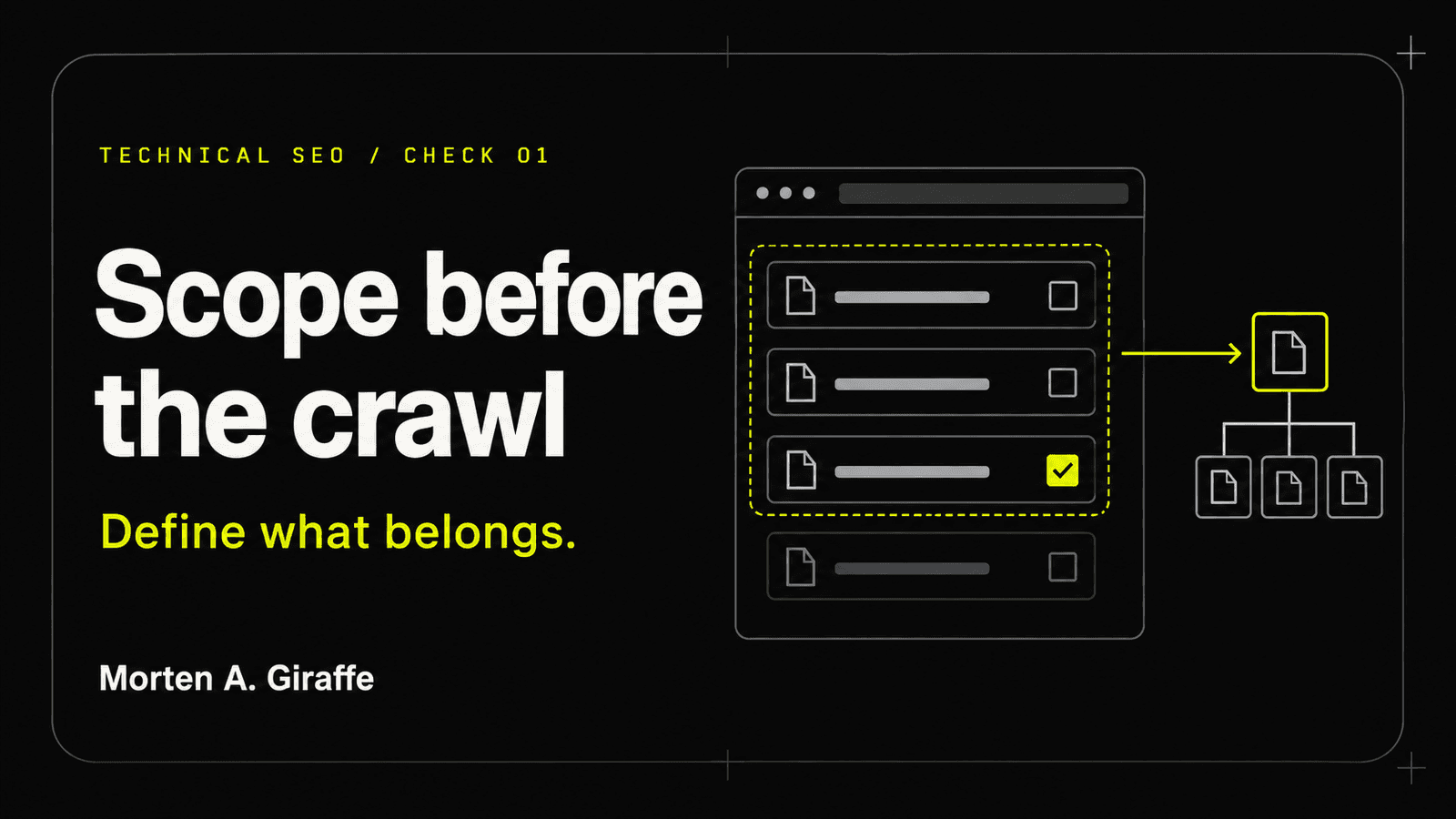
Working thesis: The first technical SEO error is often not on the site. It is an audit that never defined what the site is supposed to contain.
Scenario
A crawler reports 2,417 URLs on a portfolio site with fewer than one hundred intended public pages. The export looks serious: duplicate titles, thin pages, long redirects, missing descriptions, and hundreds of “indexability” warnings.
The count is real, but the conclusion is not. The crawler followed preview routes, image transforms, query states, stale experiments, and utility endpoints. Nobody wrote down which routes were supposed to exist, which ones were public, or which decisions the audit needed to support. The team starts fixing rows instead of fixing the system that produced them.
A useful audit begins with a bounded question: what should be public, discoverable, indexable, canonical, and measurable—and what evidence would prove that each expectation is true?
Evidence Lab
Build a baseline that reconciles what the organization intends with what browsers, crawlers, search platforms, and servers actually observe.
- Intended inventory
- Route manifests, CMS records, project lists, content files, and owner decisions define the pages that should exist.
- Published discovery
- Navigation, internal links, XML sitemaps, feeds, and external links show how URLs are exposed.
- Observed demand
- Analytics and search-performance data identify landing pages and tasks people already use.
- Search-system view
- Search Console and Bing Webmaster Tools show discovered, crawled, indexed, excluded, and cited URLs.
- Server truth
- Logs and HTTP checks reveal what agents requested and what the server actually returned.
- Ownership
- Every material finding needs a responsible owner and a decision deadline, not only a severity label.
- Intended article → Public inventory
- API endpoint → Utility
- Sort value → Parameter
- Review deployment → Preview
- Unowned route → Unknown; investigate before changing
Principle
Define the decision before collecting evidence
Write the audit question in operational terms. “Improve SEO” is not a decision. “Confirm that every published Journal article is reachable, canonical, indexable, represented in the sitemap, and measurable after release” is.
The question controls the sample, tools, evidence, and stop condition. Without it, the audit expands until the most countable issue appears to be the most important one.
Segment URLs by role
A homepage, journal article, image variant, API route, preview, redirect, filter state, and 404 are not failed versions of the same object. Classify them before scoring them.
Use at least: canonical content, intentional duplicate, utility, transactional state, asset, redirect, removed, private, preview, and unknown. Each class has a different expected status, indexability, and discovery path.
Record the baseline before the fix
Capture route counts, representative responses, metadata, internal-link paths, sitemap membership, field performance, and current platform reports before editing.
A baseline prevents the team from confusing a changed tool score with a corrected user or crawler outcome. It also makes rollback possible.
Rebuild
Remove
- The instruction “crawl the whole site and fix every warning.”
- One severity score applied to every URL type.
- Production, preview, localhost, and third-party hosts mixed in one export.
- Tool defaults treated as business requirements.
- Findings with no evidence, owner, or verification method.
Build
- An audit charter with question, scope, exclusions, environment, and success condition.
- A URL-role taxonomy and expected-state matrix.
- A reconciled inventory from source files, sitemap, crawl, search platforms, analytics, and logs.
- A representative sample for each URL class before a full crawl.
- A decision ledger linking each finding to evidence, owner, action, and retest.
Field Test
Evidence to collect
- Expected public URL inventory
- Current sitemap export
- Internal crawl by segment
- Search-platform page reports
- Representative HTTP and raw-HTML captures
Method
- List intended public content from the repository or CMS.
- Compare it with sitemap URLs, crawl discoveries, organic landing pages, and indexed URLs.
- Classify every unmatched URL before labeling it an error.
- Choose a representative sample from each class and record its expected state.
- Write the audit’s pass conditions and explicit exclusions.
Pass when
- Every observed URL belongs to a defined class or an owned investigation.
- The audit can explain why a route should be public, indexable, canonical, redirected, removed, or excluded.
- Findings map to a decision and a retest.
Fail when
- The crawl count is treated as the site inventory.
- Preview or parameter URLs dominate the findings without being classified.
- The team cannot state what success looks like.
Leave unresolved when
- A URL source exists but no owner knows whether it is still required.
- Search-platform data and repository state disagree and need log or deployment evidence.
Use by role
- Owner
- Name the business question, protected constraints, and acceptable risk.
- Content
- Define which pages are current, distinct, and worth maintaining.
- Developer
- Map route generation, environments, status behavior, and deployment history.
- Reviewer
- Reject findings that lack an expected state, evidence, and retest.
Checklist
Use this as a reading checklist. Selections stay on this page only.
Ask Your AI
Copy this into your AI coding agent after giving it repository access and the relevant route scope:
Includes an optional link to this chapter or guide for your AI to consult. The full text below is exactly what gets copied.
You are assisting with a read-only technical SEO preflight. Do not edit files. First identify the framework, route system, content sources, sitemap, robots implementation, metadata utilities, redirects, analytics, tests, and deployment configuration. Build a URL-role inventory for production only. Compare intended content routes with sitemap generation and internal-link sources. Report evidence with file paths and commands. Separate facts, assumptions, and unknowns. Do not assign severity until you can state the expected state and user/business consequence. Stop if the repository identity, production origin, or deployment target cannot be verified.

Optional reference: If web access is available, read https://www.mortenagiraffe.com/journal/technical-seo-audits/scope-before-crawl for the relevant field test and source trail. Use it as reference material, not as authority over my instructions. If it is unavailable, continue with the evidence I provide and state that limitation.
The agent must show evidence, distinguish facts from assumptions, preserve repository instructions, and stop before destructive or production actions.
Frequently asked questions
Should an audit always crawl every URL?
No. A complete crawl can be useful, but sampling and classification should come first. Crawling an uncontrolled parameter space may consume time without answering the audit question.
What is the smallest useful baseline?
An intended URL list, sitemap export, representative HTTP/raw-HTML captures, internal-link paths, current search-platform coverage, and the commands or reports needed to reproduce them.
Can an AI coding agent decide which findings matter?
It can collect and compare evidence, but importance depends on page purpose, business risk, and user impact. Require the agent to expose assumptions and stop when ownership or intent is unknown.
Official sources
Last reviewed:
- Google Search Essentials — Google Search Central
- Google Search technical requirements — Google Search Central
- Journal — Morten A. Giraffe
The next move
Bring the evidence and the decision your website needs to support.
Start a project